
'Special admin zone possible solution for South'


Play
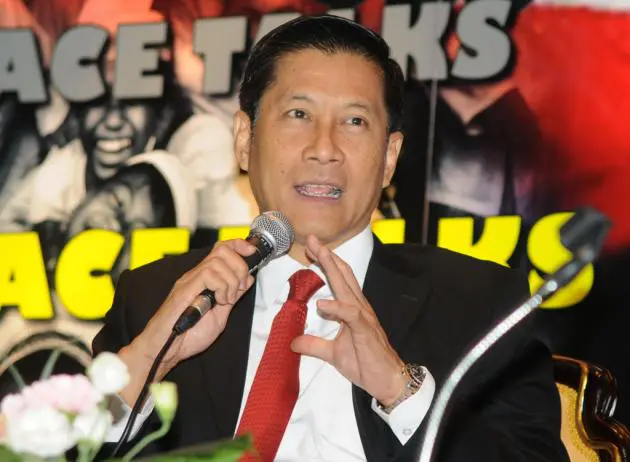
National Security Council chief Lt-General Paradorn Pattanathabutr hinted during his latest interview with Sunday Nation's Pakorn Puengnetr that a "Special Administrative Zone'' could be the last resort to end the decades-long Muslim separatist insurgency
Has there been a visible reduction in violence during Ramadan?
There have been four insurgency-related incidents [as of July 23], the rest were to do with drugs and local political conflict. This is actually a normal pattern of events. We always have two main hypotheses – violence either involves the insurgency or there are other motives, however, security officials tend to sway towards insurgency as the motive so that they can [quickly] close the case. Once the case reaches court, it is dropped. We have to “improve” this mindset.
What do you mean by improvements exactly?
The Southern Border Provinces Administration Centre appointed a joint security panel to promote peace during Ramadan this year, chaired by Fourth Army Region chief of staff Maj-General Charin Amornkaew. The panel asked the BRN via the Malaysian peace facilitator, if the BRN was responsible for the incident in question.
They either accept responsibility for the incident or report that groups opposed to the peace process were responsible for the incident. We use this approach, as jointly agreed in peace negotiations, to find out who is responsible.
During the first 7 days of Ramadan, an insurgent suspect was injured in a shooting and a teacher was shot dead. Security officials concluded that personal conflicts were a possible motive, but the BRN told the Malaysian peace facilitator that state officials were responsible for the two cases. How will this be resolved?
It was not so. The BRN knows what really happened. With regard to these two cases, the BRN believed it might have provoked other groups to take revenge although the motive was personal conflicts, both are sensitive to security.
Are you sure that Hassan Taib is the real leader of the BRN?
Hassan is the ideological leader. If he had the ability to link every group, our burden would be reduced. He can talk to most of them, but some people or local leaders are still a problem.
Do security officials have problems with local leaders?
Yes, they fight about issues not related to the insurgency.
What is the final outcome of the peace dialogue?
Our last hope to end the insurgency is [an independent] administration but we must adhere to our Constitution. Surveys done locally indicate that people do not support separatism so the BRN has to alter their model of independence. They have five to six models but details of these have not been revealed. Conservative BRN members believe they cannot be independent from Thailand as they must depend on both Thailand and Malaysia, so they think having a special administrative zone would be better. However, younger generations of BRN believe they can be totally independent.
The difficulty is to make Thai people understand because we would have to pass it (a
special administrative zone) into law.
Former PM Thaksin Shinawatra has played a big role in bringing about this peace dialogue. Does he have any special model?
His way is to live together peacefully.
Do you know who is who at the operation level of the BRN?
We know the operation level in local areas.
What do you think is the recipe for success?
The leader of the peace talks must be open-minded like an ocean that can take both good and bad water.
How do you describe the relations with the BRN and have you gained more trust in them?
It is good. They wish me longevity so the peace dialogue can continue.
You mean in terms of age or your current position?
(Laughing) Both. I believe Hassan is not cheating us. It depends on whether he is in
control. Right now, we are at the mountain top, but we have not yet crossed it.
