
Experts scoff at PTTGC's response
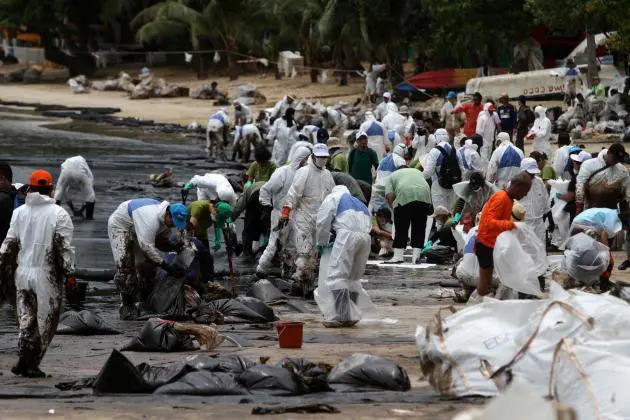


When the oil first leaked from the PTT Global Chemical (PTTGC) offshore platform near Rayong on Saturday, relevant officials decided to deploy a 200-metre boom to contain the spill, which later proved to be far too short.
Speaking on condition of anonymity, a PTTGC staff member said this 200-metre boom was the only size available in large ships.
“But we also inflated spare booms to deal with the spill,” the source, who is part of the PTTGC emergency-response team, added.
Later, in response to a model assessment produced by the Pollution Control Department, the team put out a 1,200-metre boom about 1,000 metres from Koh Samet’s Ao Phrao beach.
The PTTGC staff member added that after the booms were deployed, oil skimmers were also put into action. In addition, boats and aircraft have been spraying dispersant chemicals on Sunday.
“We have been proceeding in line with international practice on responding to oil spills,” he said, adding that nobody thought the oil would wash up at the Ao Phrao beach on Sunday night.
“In fact, we believed we could stop the oil about 4 kilometres from Ao Phrao,” he said, adding that the oil was possibly pushed toward the beach by high tides and strong winds.
He added that since Thailand did not have chemical-spraying aircraft, PTTGC had to wait for help from Singapore-based Oil Spill Response Ltd. “The aircraft started spraying the chemicals at about 3pm on Sunday,” he said. “By then, the oil slick had already spread over quite a wide area.”
Dispersants ‘safe’
He went on to say that he was confident the dispersants would not affect the coral or marine life because the droplets would go just a metre or two under the surface of the seawater.
“At that depth, the chemical won’t reach the abode of aquatic animals. Then within three to four weeks, sunlight and bacteria will naturally dispose of all those droplets,” he said.
However, academics remain unconvinced.
Phaitoon Mokkongpai, a researcher at Burapha University, explained that the coral around Koh Samet did not lie that deep below the water surface. “Most of them will be affected,” he said.
Thon Thamrongnawasawat of Kasetsart University’s Faculty of Fisheries said several studies show that when chemicals are used in waters less than 20 metres deep, they pose some risks.
According to Phaitoon, the PTTGC boom was also shorter than is required, which explained why the spill spread. “If you ask me, PTTGC’s response was not the best,” Phaitoon said.
