
Govt's approval rating sinks to a new low


Play
At the halfway point in its four-year term, the Yingluck government's job approval rating has sunk to its lowest level, according to Bangkok University Poll.
On a scale of 10, the government scored 4.49, down 0.38 from the 18-month point in its term. The government scored the highest mark of 5 for its achievements in foreign affairs and the lowest mark of 3.98 for its economic performance.
About 55 per cent of respondents said they did not know where the Yingluck government was leading the country, while 27 per cent believed it was leading Thailand in the right direction. Some 17 per cent believed the country was being led in the wrong direction.
Prime Minister Yingluck Shinawatra was given a job approval rating of 4.9, slipping by 0.48 to the lowest level since she took office. Her diligence and devotion to solving problems was rated at 5.4 and her decisiveness was the least impressive at 4.5.
Corruption in various projects has done the most damage to the government’s image, at 19.9 per cent, followed by corruption and losses in the rice-pledging scheme at 19.3 per cent, and failure to stem the rising cost of living at 11.1 per cent.
The poll was conducted recently on 1,419 people across the country.
Abac Poll surveyed 2,114 respondents from July 28-August 3 and found that the issue of passing an amnesty bill presented the greatest political risk with a score of 9.19 on a scale of 10, followed by political interference at 8.6 and the Bt2-trillion loan bill at 8.2.
Puntharee Isarankura na Ayuthaya, assistant director, said the government is vulnerable due to many factors, especially conflicts over amnesty, which may spark violence. The respondents suggested that the government suspend or call off the deliberation on the amnesty bill.
“Politicians who favour high risks, especially businessmen-cum-politicians, must beware and not carry risks too long. Their duty in democracy is to reduce conflicts, not provoke them or become the cause of conflict.”
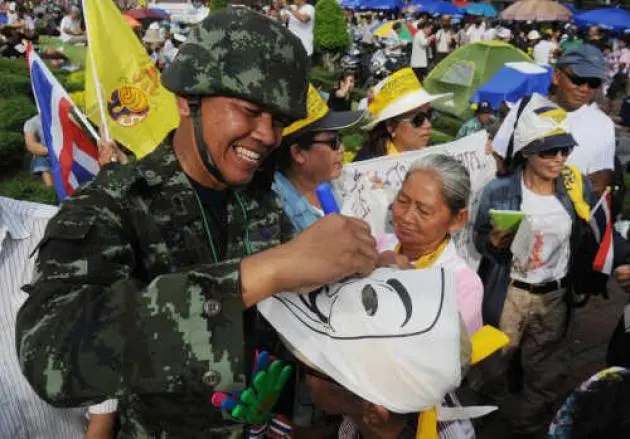
Dusit Poll’s interviews of 1,176 people from July 29-August 2 showed that 54 per cent were fed up with political rallies because they caused national divisions and hurt the country’s image.
About 25 per cent believed political rallies can be kept within the scope of the law, 11 per cent said state officials must have efficient controls to prevent ill-intended groups from creating a situation, and 9 per cent said they feared loss of life and property as a result of political rallies.
About 37 per cent said political groups have the right to protest against an amnesty bill, 33 per cent said they opposed the rallies since they worked against the country’s image and economy, and 29 per cent supported the rallies for helping to raise political awareness.
