
Plan to help rehabilitate Koh Samet to go to Cabinet


Play
1,000 fishermen petition governor and PTTGC for 'fair compensation'
The Cabinet will consider a rehabilitation plan for Koh Samet next Tuesday, after the oil spill that hit Ao Phrao beach and damaged the island’s marine ecosystem – and tourist trade.
The Natural Resources and Environment Ministry will ask Cabinet to approve the recovery plan to help repair damage to the marine ecosystem around Samet caused by the spill last month.
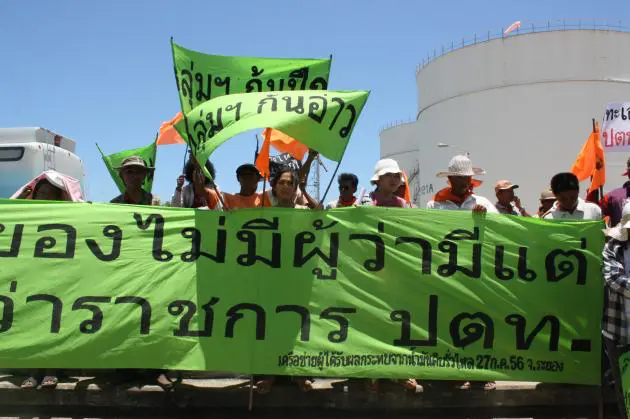
Meanwhile, a large number of small-scale fishermen yesterday called on the Rayong governor and PTT Global Chemical Plc (PTTGC), the firm responsible, to pay fair compensation for damage from the spill.
The ministry is likely to seek financial assistance from PTTGC and the Environmental Fund to support the recovery plan.
Ministry inspector Chonlatid Suraswadi, who chaired the subcommittee to monitor and rehabilitate marine and coastal resources damaged by the spill, said 27 projects were planned to help environmental rehabilitation around Samet.
The plan focuses on seven facets – the marine ecosystem, coral reefs, beaches, seagrass areas, mangroves, endangered marine species, and pollution.
If approved, the accumulation, toxicity, impact of oil dispersant would also be monitored.
“We are not only thinking about compensation but also focusing on how to rehabilitate damaged marine resources,” he said after the subcommittee meeting yesterday.
For urgent needs, such as cleaning up Ao Phrao and preventing the spread of oil to other areas, the ministry will team up with PTTGC. The ministry will also collaborate with the Pollution Control and Marine and Coastal Resources departments, plus the Office of Natural Resources and Environmental Policy and Planning (ONEP) to estimate the damage to marine and coastal resources in and near Khao Laem Ya-Mu Ko Samet National Park.
In the long term, the ministry will monitor the quality of seawater and coastal areas around Samet for contamination by polycyclic aromatic hydrocarbons (PAHs) and total petroleum hydrocarbons (TPH) for a year.
It will also monitor the level of volatile organic compounds (VOCs) to study air pollution caused by the spill at three areas including Ban Phe, Ao Phrao and Sai Kaew beach until the end of this month.
It will also check on the progress of hazardous waste elimination by PTTGC.
Coral reefs affected
According to the Marine and Coastal Department, about 6 rai of coral reef off Ao Phrao and Ao Pla Tom has been affected by the spill. The department is now trying to rehabilitate the damaged coral.
Koh Samet has about 800 rai of coral reef around the island.
Chonlatid said the ministry is monitoring whether the damaged coral could recover from bleaching, as the seawater quality was now good.
He added the coral bleaching may have been caused by “stress” that it endured.
“We might ask PTTGC to run the rehabilitation program for the damaged coral reefs as a social responsibility activity,” he said.
In related news, a group of about 1,000 small-scale fishermen in two districts in Rayong handed a petition to the provincial governor and PTTGC to ask for fair compensation for damage caused by the oil spill.
They also ask related agencies to come up with a plan to boost the environment and develop fishing in the area. A surveillance plan and the panel to monitor and prevent further oil spills also needed to be set up, Jaturas Iamworanirand, president of Small Scale Fishermen’s Association, said.
