
Tags for inmates to ease crowding
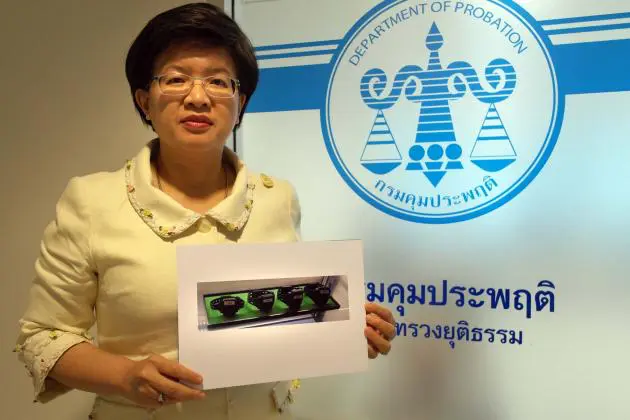


Devices to be first tried on young traffic-law violators
Thailand is set to use electronic tagging for some convicted offenders in November as a means to ease overcrowding at correctional facilities.
While 200 delinquents will be the first wearers of tagging devices, it is likely some groups of adult inmates will be in line for the tagging option soon, too.
“With electronic tagging, the young offenders will be able to return to their families, while correctional facilities will see their burden ease,” Justice Minister Chaikasem Nitisiri said yesterday.
He said the ratio of prisoners to prison officials in Thailand is now at 50:1 – about 10 times higher than the international standard.
“We have to address this problem. As a result, we have considered electronic tagging,” the minister said.
He disclosed that the Department of Juvenile Observation and Protection had planned to use the electronic tagging on young traffic-law violators first.
Probation Department director-general Ruenvadee Suwanmongkol, meanwhile, explained that the department would propose which inmates should be allowed to use the electronic tagging in place of their detention and her department would assure the court that it had the devices ready.
“We will lease 200 sets of devices from a South Korean firm with a Bt5-million budget,” Chaikasem said. He added that each set weighed just 300 grams.
He said the devices would immediately alert authorities if their wearers tried to remove them or wore them out of authorised zones.
Corrections Department director-general Suchart Wong-ananchai said the electronic tagging would be tested among the delinquents for six months before being extended to cover some groups of adult inmates too.
He suggested that these groups were inmates in terminal stages of illness, inmates who needed to take care of their helpless dependants, inmates with chronic diseases and constant need for medical treatment, and inmates with pregnancies, newborn babies, and mental illnesses.
Chaikasem said the Corrections Department planned to lease electronic-tagging devices for 6,000 inmates in these groups.
Suchart explained that although his department had operated a 500-bed hospital, it could recruit just 20 permanent doctors.
“In fact, we need as many as 50 permanent doctors. So, it’s hard for us to provide comprehensive healthcare services to all ill inmates,” he said.
Presently, there are about 270,000 inmates in the country.
He added that while prisons could send their sick inmates to a big state hospital, the process was quite complicated
“Such medical facilities do not have special rooms for prisoners. So, we worry that some inmates will try to run away during their stay at hospital,” he said.
Suchart said two prison officials were usually required to accompany an inmate when he or she went to a hospital.
“The problem is that we don’t have enough prison officials to arrange such hospital trips,” he said. Suchart said his department had already asked the Public Health Ministry to consider creating prisoner patient rooms at big state hospitals. “The Public Health Ministry has agreed to create such rooms,” he added.
