
Carcinogenic chemicals still prevalent in Ao Phrao


Play
THE LEVEL of carcinogenic substances found in the waters around Koh Samet's Ao Phrao remains high, though seawater adjacent to other parts of the island is safe to swim in, the state pollution-watch agency said.
“It is still not safe to swim in Ao Phrao,” Wichien Jungrungruang, Pollution Control Department (PCD) director-general, told the press yesterday.
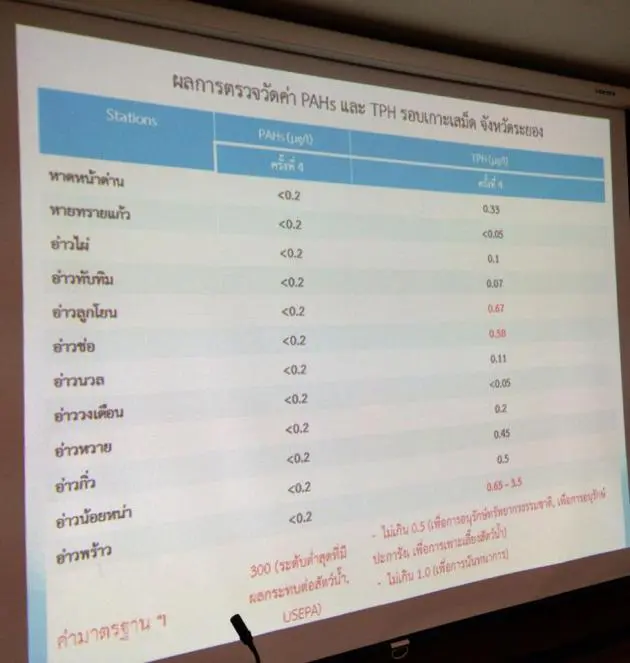
This disclosure came as a result of the fourth round of tests conducted by the department to monitor the level of contamination in seawater after oil washed up on the shores of Koh Samet last month. The hazardous chemicals detected include arsenic, cadmium and mercury as well as traces of polycyclic aromatic hydrocarbons (PAHs) and total petroleum hydrocarbon (TPH).
After the oil, which leaked from a PTT Global Chemical (PTTGC) offshore operation, washed up at Koh Samet’s Ao Phrao beach on July 28, the PCD has been closely monitoring the level of hazardous substances in the area.
For its fourth test, the PCD collected samples from 12 spots around the island on Tuesday and sent it to a private laboratory for tests.
Though the test found the levels of arsenic, cadmium, mercury and PAH to be below the maximum levels set by the United States’ Environmental Protection Agency, the level of TPH – a carcinogenic agent – at Ao Phrao was still higher than the accepted level of 0.5 microgram per litre. A high level of TPH has been detected at three spots around Ao Phrao with 0.65mcg, 2.1mcg and 3.5mcg per litre respectively.
To ensure that the water around Koh Samet and the sand on its beaches are free from contamination, the PCD will continue conducting tests at least until October. Seawater samples will be collected twice a week and the results will be revealed to the public at least once a week.
This announcement came after the Cabinet recently announced that it was withdrawing the PCD’s report on contamination levels because it deemed it an overestimation.
However, Wichien said the test results were accurate and based on scientific data.
When asked whether the department was under political pressure over its test results, he said he did not feel any pressure and did not expect the PTTGC to file a lawsuit against the department over the revelation of the test results.
