
'Trust key to reconciliation'


Play
Blair draws on his Northern Ireland experience to outline principles for overcoming the national divide
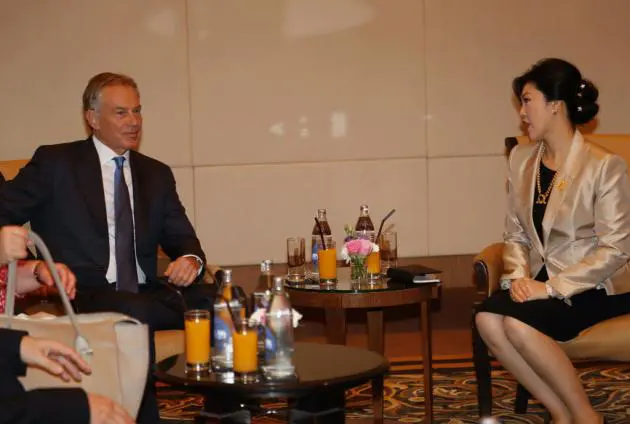
Conflict-ridden Thais should work together and build mutual trust in order to achieve reconciliation; they must respect each other, democratic principles, and the rule of law, keeping national interests in mind. Those were some of the suggestions from prominent foreign figures who spoke at yesterday’s forum “Uniting for the Future: Learning from Each Other’s Experiences”, at Plaza Athenee Bangkok Hotel.
Former British prime minister Tony Blair outlined some principles for reconciliation, which he said could be appropriate to the situation in Thailand, as the country seeks ways to end its long and deep national divide.
Blair said he had been invited, but not paid, to attend the forum to share his experiences on seeking reconciliation in Northern Ireland when he was PM in 2005.
Reconciliation depended mostly on local context, but there were some common basic principles that could be applied as guidelines, he said.
First, he said, reconciliation occurred when the sense of shared opportunity was greater than other issues. Thailand is a country of opportunity with a growing economy, large population, a rich culture and history, he said.
“The shared sense of opportunity and potential is large – but you need united determination to overcome the past in order to exploit this sense of opportunity,” Blair said.
Secondly, he said, all countries have differences and historical pain to reconcile. The past conflict can be honestly examined but it can never be in a way just to reach satisfaction for everyone.
“You have to accept there will remain two sides of narrative about the past that in a way you can never get over. But you can examine the past in a way to move forward to the future,” he said, and gave the example of different narratives of the Irish Republican Army (IRA) and the victims of its violence.
The third principle, Blair said, was to have a framework for the future that is just and objective. The root cause of the conflict must be addressed properly. In the case of Northern Ireland, the IRA and the British government needed to reach a deal on power-sharing, while the majority of people in Northern Ireland wanted to remain a part of the United Kingdom, he said.
Fourthly, a crucial path for reconciliation is genuine democracy, Blair said.
“Democracy is not just a way of voting but also a way of thinking. Democracy is not just about how a majority takes power, it is how the majority relates to the minority,” he said.
The former British premier said the “rule of law” must be independently and impartially followed. “It is important precisely to make citizens believe when they are in a court, [it] would decide objectively,” he said.
The last principle, Blair said, was effective and responsible government. Reconciliation was easier to achieve if the politics of the country as a whole was effective in delivering improvements to the people, he said.
“One basic lesson – the delivery works when you reach out and try to build the bridge in a non-partisan way,” Blair said.
Finland’s former president, Martti Ahtisaari, said he agreed with Blair that a country should not try to forget the past in order to achieve reconciliation. “But we have to keep in mind that we must also look to the future,” he said. Trust was the key element for reconciliation, he said.
“Trust would be built by giving people a tool and architecture for their own future. National leaders have to create political space to save the national agenda.”
If any nation is about to build trust, it has to choose and open a wide road to walk together with anyone who is interested. Negotiation can do only part of the job. True reconciliation can only be found in the behaviour of all people, he said.
Priscilla Hayner, an independent expert on transitional justice and senior adviser to the Centre for Humanitarian Dialogue, told the same forum that people could understand the concept of “reconciliation” differently. It could be also misused.
Sometimes the reconciliation approach was used for political whitewashing, she said. Reconciliation must not contain hidden agendas, not be used for overcoming opposition to achieve one’s own political agenda.
Reconciliation must be able to build trust between parties to identify the common national interest. It cannot be rushed into reconciliation, she said.
Hayner, who worked with the now defunct Independent Truth for Reconciliation Commission, said the amnesty law that Thailand desired as an instrument for reconciliation should not just serve specific political issues. It should offer a fair process and not ignore the rights of victims, she said. Investigations to establish truth could be continued even after an amnesty was put in place, she said.
International principles for amnesty might not apply to everyone, but “I hope basic principles could be matched and should be committed in democratic principles,” she said.
Nicha Hiranburana Thuvatham, widow of Colonel Romklao, who was killed during the red-shirts’ unrest in April 2010, asked the forum how trust could be built with the current government, which was a party involved in the conflict. Blair said he understood her feeling of loss but it would not be appropriate for him to directly respond to that question. He said the government had to listen to victims as well as trying to communicate with the public in building trust.
Former Asean secretary-general Surin Pitsuwan, speaking from the audience during the forum, said that during Thailand’s conflict, someone politically powerful made frequent Skype calls to Thailand.
Blair seemed about to respond to Surin’s comment when the moderator adjourned the morning session.
