
K-water eyes Chao Phraya River basin as possible future project


EVEN THOUGH the Korea Water Resources Corporation (K-water) has yet to sign a contract with the government, the agency has been closely studying the Chao Phraya River basin and the possibilities of restoring it.
Han Goo Lee, director of K-water’s Southeast Asia Department, said his agency was studying to see what was needed to restore and develop the Chao Phraya River basin and had realised that it could be based on the Four Major Rivers restoration project.
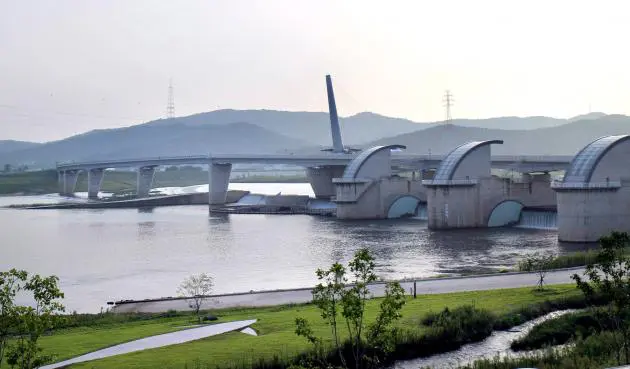
The Four Major Rivers project was aimed at restoring South Korea’s four main rivers – Han, Nakdong, Geum, and Yeongsan. The project also covered other rivers such as Seomjin River as well as 13 major tributaries. Waterways built under this project helped prevent flooding during the rainy season.
With an investment of US$200 million (Bt6.4 billion), K-water began this project in October 2009 and completed it in December last year. Under the project, two new dams and 16 multi-purpose weirs were installed to control the level and flow of water.
It also established 16 small hydropower stations in the rivers.
Lee went on to explain that this project can handle huge floods as it has the capacity to control as much as 920 cubic metres of water, as well as improve and restore the ecosystem along the river through the development of wetlands and readjustment of farmland.
Even though Thailand and South Korea are different geographically, Lee said this was not an obstacle as there are some similarities in the North.
“We hope this project will be able to improve the capacity of the Chao Phraya River basin both in terms of floods and drought,” he said.
However, since the Four Major Rivers project started operating, there have been several concerns about the environmental impact, such as algae overgrowth in the area this year.
Lee said the algae overgrowth could have been caused by many factors, such as pollution and rising water temperatures, which were not related to the project.
Previously, algae overgrowth had taken place in 1996 and |2005, which has been the worst so far.
When asked about K-water’s measures to monitor the impact of the rivers’ flow or the migration of fish after the project was completed, Lee said the scheme had restored the rivers and now their eco-systems were friendly enough for fish to flourish.
Byung-hoon Yune, vice president of K-water’s Overseas Business Division, said if his company’s pact with the Thai government also covered the restoration of the Chao Phraya River basin, the two countries could team up and swap flood-management know-how in the future.
