
Global chemical watchdog wins Nobel Peace Prize


Play
The Organization for the Prohibition of Chemical Weapons won the Nobel Peace Prize on Friday for working to eliminate the scourge that has haunted generations from World War I to the battlefields of Syria.
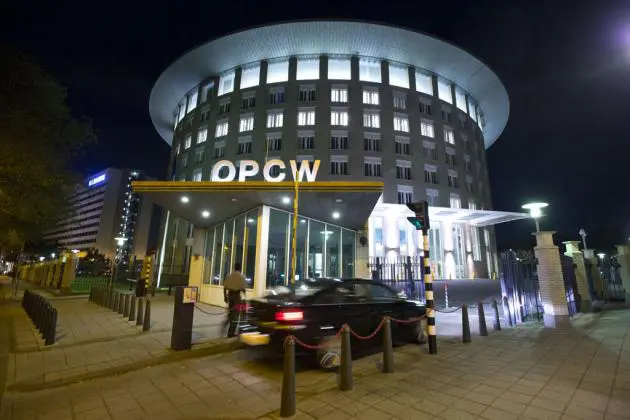
Based in The Hague, Netherlands, the OPCW was formed in 1997 to enforce the Chemical Weapons Convention, the first international treaty to outlaw an entire class of weapons. It had largely worked out of the limelight until this year, when the United Nations called on its expertise to help investigate alleged chemical weapons attacks in Syria.
``The conventions and the work of the OPCW have defined the use of chemical weapons as a taboo under international law,'' the Nobel committee said. ``Recent events in Syria, where chemical weapons have again been put to use, have underlined the need to enhance the efforts to do away with such weapons.''
Friday's award comes just days before Syria officially joins as the group's 190th member state. OPCW inspectors are already on a highly risky UN-backed disarmament mission based in Damascus to verify and destroy Syrian President Bashar Assad's arsenal of poison gas and nerve agents amid a raging civil war.
The OPCW's director-general, Ahmet Uzumcu (AKH'-meht ooh-ZOOM'-joo), said the award was a recognition of the group's work for global peace in the past 16 years.
``But (it's) also an acknowledgement of our staff's efforts, who are now deployed in Syria, who have been, in fact, making a very brave effort there to fulfill their mandate,'' he told Norwegian public broadcaster NRK.
By giving the award to the largely faceless international organisation, the Nobel committee found a way to highlight the devastating Syrian civil war, now in its third year, without siding with any group involved. The fighting has killed an estimated 100,000 people and forced millions of Syrians to flee their homes, according to the UN
UN war crimes investigators have accused both Assad's government and the rebels of wrongdoing, although they said earlier this year that the scale and intensity of rebel abuses hasn't reached that of the regime.
In the past, Albania, India, Iraq, Libya, Russia and the United States, along with a country identified by the OPCW only as ``a state party'' but widely believed to be South Korea, have declared stockpiles of chemical weapons and have or are in the process of destroying them.
However, the committee noted that some countries have not observed their deadlines.
``This applies especially to the USA and Russia,'' committee chairman Thorbjoern Jagland said.
After an Aug. 21 chemical weapons attack that killed hundreds in Syria, Assad was faced by the prospect of possibly devastating US strikes against his military. To avert that, he admitted his chemical weapons stockpile and his government quickly signed up to the Chemical Weapons Convention and allowed OPCW inspectors into his country.
Syria is scheduled to formally become a member of the organisation on Monday.
The first OPCW inspection team arrived in Syria last week, followed by a second this week and they have already begun to oversee the first stages of destruction of Assad's chemical weapons.
According to the OPCW, 57,740 metric tons, or 81.1 per cent, of the world's declared stockpile of chemical agents have been verifiably destroyed. Albania, India and ``a third country'' _ believed to be South Korea _ have completed destruction of their declared stockpiles.
An OPCW report released earlier this year said the United States had destroyed about 90 per cent of its stockpile, Russia had destroyed 70 per cent of its chemical weapons and Libya 51 per cent.
Among nonmember states are North Korea, Angola, Egypt and South Sudan. Israel and Myanmar have signed but not ratified the convention.
The European Union won the 2012 Nobel Peace Prize.
The peace prize was the last of the original Nobel Prizes to be announced for this year. The winners of the economics award, added in 1968, will be announced on Monday.
WHERE DID THE OPCW COME FROM?
The Organization for the Prohibition of Chemical Weapons was thrust into the spotlight in recent weeks when it was required to oversee the destruction of chemical weapons in Syria, but it has been working since the 1990s as the body that implements the Chemical Weapons Convention, the first international treaty to outlaw an entire class of weapons.
WHAT DOES THE TREATY DO AND WHO IS A MEMBER?
The convention prohibits the development, production, acquisition, stockpiling, retention, transfer or use of chemical weapons. It came into force in 1997 and has been ratified by 189 states. Of those, seven — Albania, India, Iraq, Libya, Russia and the United States, along with a country identified by the OPCW only as "a State Party" but widely believed to be South Korea — have declared stockpiles of chemical weapons. These include mustard gas and nerve agents like sarin and VX.
Syria is due to become a member state of the organization on Monday and has acknowledged having chemical weapons. Non-signatories to the treaty include North Korea, Angola, Egypt and South Sudan. Israel and Myanmar have signed but not ratified the convention.
WHAT DOES THE OPCW DO?
The OPCW has conducted more than 5,000 inspections in 86 countries. It says 100 percent of the declared chemical weapons stockpiles have been inventoried and verified.
According to its statistics, 57,740 metric tons, or 81.1 percent, of the world's declared stockpile of chemical agents have been verifiably destroyed. Albania, India and "a third country" — believed to be South Korea — have completed destruction of their declared stockpiles. An OPCW report released earlier this year said the United States had destroyed about 90 percent of its stockpile, Russia had destroyed 70 percent and Libya 51 percent.
Thirteen OPCW members have also declared a total of 70 chemical weapons production facilities. The organization says all 70 have been taken out of commission including 43 destroyed altogether and 21 converted to peaceful purposes.
WHO RUNS THE OPCW?
The OPCW is funded by its member states and had a budget of some €74 million euros ($100 million) in 2011. It employs some 500 people in The Hague. The director-general is Turkish diplomat Ahmet Uzumcu.
