
New lease of life for city's forgotten bicycle routes
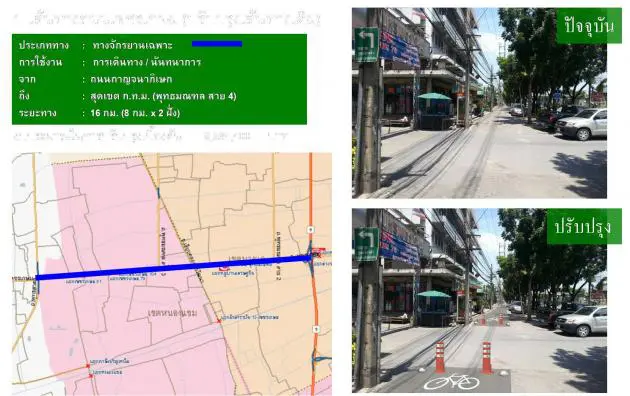


THE BANGKOK Metropolitan Administration (BMA) is planning to fully revive 10 bicycle routes as part of a scheme to reinvigorate the capital's 35 bikeways.
Information on the revival plan, and on the support needed from various parties, will be presented at a day magazine’s “a day BIKE FEST 2013” at the Airport Rail Link’s Makkasan Station. The event runs until Sunday.
“Whether these bicycle lanes will be a success depends on cooperation from people, local communities and police,” Threedow Aphaiwongs said in her capacity as chair of the We Love Bangkok: We Love Bicycles Committee.
As many as 35 bicycle routes have been created in Bangkok to date. However, contrary to their founding objectives, they are little used by bicyclists these days.
“Some cars park on bicycle lanes,” Apichart Tiankaew pointed out.
This 31-year-old engineer has been cycling along the bicycle route in Bangkok’s Bang Khunthien district for years now.
He said the 10 routes, including one in Bang Khunthien, due for full revival, are among the existing 35 bicycle-lane routes.
“We hope to start improving these 10 routes early next year. After the work is completed, Bangkok residents should be able to enjoy better bicycle lanes,” she said.
If all 35 bicycle-lane routes are fully restored, Bangkok’s bicycle lanes will stretch for well over 200 kilometres.
Bangkok Governor Sukhumbhand Paribatra has a policy to provide bicycling as an alternative means of transport for city people.
“Bicycling can reduce pollution and travel expenses,” Threedow said.
In Bogota, Colombia, mayor Enrique Penalosa has successfully created a bicycle boom in the capital. During his term as its mayor between 1998 and 2001, he prescribed strict legal enforcement to allow people to ride easily along the routes and ensured that the bicycle routes reached all impoverished communities. Bogota’s bicycle network now stretches over 300 kilometres. It is also well linked to transportation systems.
Thanks to Penalosa’s revolutionary moves, traffic jams in Bogota have eased by 40 per cent. The air quality and quality of life have improved, and Penalosa’s successors are all in support of the bicycle-support policies.
