
Pheu Thai braces for the worst


Play
Experts on both sides agree court is not likely to back charter-change legislation
The ruling Pheu Thai Party is preparing for the worst-case scenario on Wednesday when the Constitutional Court announces its ruling on the proposed amendment of the Constitution, a decision that could bring the government down.
The opposition Democrats and some senators have asked the court to rule on whether the bill to amend the Constitution, which was sponsored by 312 lawmakers, is lawful.
Last week, key members of both Pheu Thai and the Democrats analysed possible scenarios for the court’s judgement. Both agreed the chances that the court would hand down a verdict that is in favour of the government were very slim.
Pheu Thai chief Jaruphong Ruangsuwan said yesterday that he was worried about the court judgement, as it might pose a risk to the party and eventually seal the fate of the government under Prime Minister Yingluck Shinawatra.
Under the proposed amendment, all 200 senators would be elected, rather than having 76 elected and 74 appointed as currently. Also, the amendment would allow the relatives and spouses of sitting parliamentarians to run. The opposition is worried that the amendment would allow the government to bring its associates into the Senate easily.
Analysts see three likely choices for the court.
One is for the court to declare the charter amendment unconstitutional and order the process stopped, even though Yingluck has already submitted the amendment to the Palace for royal endorsement. The second would extend the first option by requiring the 312 MPs and senators who sponsored the charter-amendment bill to take responsibility.
The third would be for the court to rule the amendment unconstitutional on grounds that it attempts to change the country’s system of government. The court could then dissolve the ruling parties that supported the amendment, including Pheu Thai, and ban their executives from politics.
That means four political parties would be disbanded and 55 politicians banned for five years, including 19 executives of Pheu Thai, 11 of Chart Thai Pattana, 17 of Chart Pattana and eight of Phalang Chon. Among them, four are ministers – Pheu Thai leader Jaruphong, his deputies Kittiratt Na-Ranong and Plodprasop Suraswadi, plus Phalang Chon leader Sontaya Kunplome.
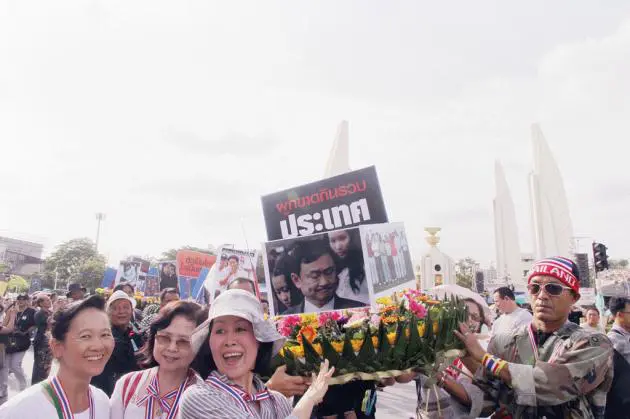
Yingluck could survive the ruling, but the Democrats would pressure her to take responsibility, said a senior Democrat member, who has joined in the rally at Democracy Monument.
“Democrat MPs have warned her to delay the submission [of the charter-change legislation] for royal endorsement, but she decided to rush the process. She cannot deny responsibility,” he said.
Legal experts at Pheu Thai hope that the court would simply rule the amendment unconstitutional and order it stopped, but there is also a high possibility that the court would go so far as to outlaw parties involved.
The key concern is that four or five top Pheu Thai Party executives are among the 312 lawmakers who sponsored the charter change.
Three of the nine justices are likely to have dismissed the petition citing a lack of authority to rule on the constitutional amendment, Pheu Thai experts said. They are Chut Chonlavorn, Boonsong Kulbupar and Udomsak Nitimontree.
The new member, Twekiat Menakanist, might also excuse himself or abstain from voting, as he has not worked on the case from the beginning. The ruling could then come down to the opinions of five justices, they said.
If the court ruling favours the opposition, it could calm protesters led by senior Democrat Suthep Thaugsuban. But red-shirts would probably take to the streets instead.
