
PDRC's broadcast demand slammed


Play
Say protesters' pressure on TV stations was undemocratic
Media academics yesterday slammed as undemocratic the demand by anti-government protesters for television stations to broadcast their announcement.
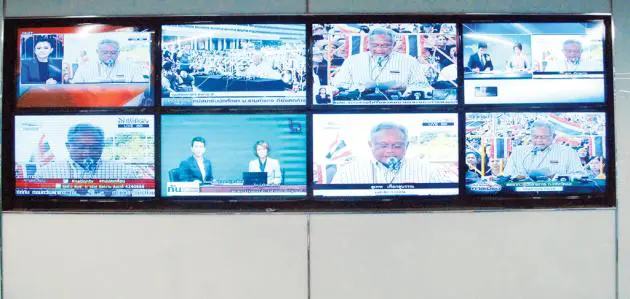
The People’s Democratic Reform Committee (PDRC) yesterday laid siege to six free-to-air television stations and demanded that they televise a speech by Suthep Thaugsuban, secretary general of the PDRC, in the evening. While some action had been expected against five of the stations, the inclusion of Thai PBS among the targeted channels – and the demand that the speech be televised – were unexpected.
“This was like an act of a kind of dictatorship performed under a group of people, which was undemocratic,” veteran journalist Somkiat Onwimon tweeted yesterday.
He said the demonstrators should not put pressure on or intimidate the media. What they had done was not consistent with the democracy they claimed to want to build.
“To seize television stations to control the broadcast signal is a threat to force people to listen to only one side of a story. So where is the freedom?” he wrote.
If the protesters were truly democratic they would have allowed the media to check on what they said on the stage. If they distorted the information on their stage, media outlets could scrutinise them.
Somkiat urged all media stations not to bow to pressure from the protest group.
Pirongrong Ramasoota Rananand, a lecturer at Chulalongkorn University’s Faculty of Communication Arts, said the PDRC’s justification for occupying free TV stations to issue a revolutionary discourse was deeply flawed, if they still insisted that their end was democratic reform. The “blind spot” was that only dictatorial military juntas take over the media to monopolise information disseminated to the public.
The people’s right to know and the news media’s freedom of expression were guaranteed in the Constitution, along with people’s freedom of assembly. It was important not to rationalise the use of undemocratic means with a supposedly democratic end. That was at best insincere and farcical.
People in the rally were now angry and easily misled. Their leaders must not exploit rally sentiments for obscure gains.
The protesters’ strategy was to seize all free TV stations to televise speeches made by Suthep. They also demanded that Thai PBS televise the Blue Sky channel (affiliated with the Democrat Party). Protest leaders tried to negotiate with station executives to follow their demands.
All six free channels except NBT, which served a live interview of Wim Rungwattanajinda, Secretary to PM’s Office Minister, on its special programme, finally televised Suthep’s announcement.
Earlier, Sakoltee Phattiyakul, a core PDRC member, suddenly changed his plan from occupying the Commerce Ministry to target Thai PBS on Vibhavadi Rangsit Road. Sakoltee called on Thai PBS executives to provide a broadcast link to the Government Complex rally so protest leaders’ speeches could be broadcast live. Tense negotiations between Thai PBS and Sakoltee went on for several hours.
Thaworn Senneam, who led the protest to NBT, said earlier that NBT executives also agreed to hook up a signal carrying Suthep’s statement on air. However, the protesters remained at NBT to see if Suthep was televised.
