
Graft fight a 'national priority'


Play
Prayuth reaffirms his commitment to tackling issue that has 'divided' Thais
Prime Minister General Prayuth Chan-ocha has promised that his government regards the fight against corruption as a national agenda assignment and a key element of national reform.
Speaking yesterday, he said that corruption would be among the first reform issues to be tackled, adding that the problem had been accumulating for a long time in Thailand and was causing severe damage to the country’s economy and reputation.
Prayuth blamed the deep-rooted problem for the social division and political conflict which led to fatal street protests and other violent acts over the past decade.
“The worsening corruption problem has led to political unrest, a division between people in the country, social inequality, and a bad image of Thailand in the eyes of foreigners,” he said.
“The government and the National Council for Peace and Order treats as a top priority the fight against corruption. This problem must be tackled urgently and there must be concrete results. If we allow the problem to continue, there will be more damage to the country in many ways.”
He also warned that younger people would copy the wrong values about corruption if they discovered that many corrupt officials and politicians could get away with it.
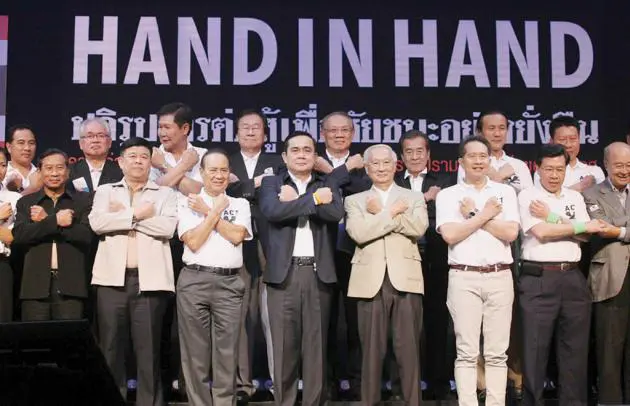
Prayuth, who also heads the NCPO, spoke while presiding over the launch of Anti-Corruption Day, which was held for the fourth consecutive year by the Anti-Corruption Organisation of Thailand (ACT).
This year’s event, with the theme “Hand in Hand – Reform the Fight for Sustainable Victory”, was held at the Centara Grand Hotel.
ACT chairman Pramon Sutivong expressed his optimism over the fight against corruption, pointing to increased support from the public.
“Over the past four years, the social attitude towards corruption has shifted from the realisation of considerable damage caused by corruption to an intolerable feeling [about it],” Pramon said.
“Thais have joined hands to take action for tangible results. This year marks a remarkable year for Thailand as we have seen the public and private sectors reconcile. The two sectors have prominent roles in suppressing corruption effectively.”
Noted figures yesterday presented their anti-corruption vision and measures at the ACT’s event.
National Security Council secretary-general Thawil Pliensri said human greed was beyond anyone’s imagination. He said recent surveys showed that “under the table” money accounted for 20-60 per cent of the cost of projects due to conspiracies by politicians, civil servants and businessmen. It was time Thais united to stop corruption, he said.
“If you want to be corrupt, you should think of low-ranking officials and poor people in the upcountry and you may want to stop corruption,” he said.
Commerce Ministry permanent secretary Chutima Bunyaprapatsorn said to prevent corruption in the long run it was vital that people were instilled with good values so they did their job with integrity.
“The anti-corruption job is not optional. Everyone has the duty to clean up the country so that it is free of corruption,’’ she said.
Thai Chamber of Commerce president Issara Wongkusolkit said the agency was determined to build a corruption-free society and instil Thais with honesty and integrity.
Federation of Thai Industries president Supan Mongkolsuthee said corruption would not be wiped out if it were not attacked at the root causes and without harsh punishments being imposed.
He said one of the anti-corruption measures was to disclose the names of companies with transparency issues.
Engineering Institute of Thailand president Suchatvee Suwansawat said the agency would like to take part in the fight against corruption with the goal of a sustainable victory.
“If we do not do this part, what does the future hold for our children?” he said. “Corruption is the root cause of every problem. It destroys the dreams of the next generations and stops opportunities being given to competent people who want to bring about innovation for the country.’’
