
Farmers plan for severe drought next dry season


Play
Residents in downstream Central provinces need not worry about flood threats for the rest of the year, as the country's water specialists predict that a drought is on the way.
The country’s dry season is due to start on November 1 and run till April 30 next year.
“We will likely face severe drought,” Lertchai Srianant said in his capacity as an assistant to the Royal Irrigation Department (RID)’s director-general. He is also a senior expert on Irrigation Engineering and Irrigation.
He has backed up his drought prediction with water volume reports available at major dams across the country.
Of 33 dams nationwide, four major facilities hold a relatively small volume of water.
Levels are running at just 38 per cent of the Bhumibol Dam’s total capacity, at just 54 per cent of the Sirikit Dam’s capacity, at 64 per cent of the Kwai Noi Dam’s capacity and at 61 per cent in the Pa Sak Jolasid Dam.
Lertchai has blamed the low water levels on poor rainfall this season.
He said downstream Central provinces would not be facing any real flood threat during the last quarter of this year because they had little water left and could take in a huge volume of water.
“Even if there were heavy downpours, the Central region would still be doing fine,” Lertchai said.
“And even if tropical storms come, our big dams can still accommodate much water.”
His concern, however, was that when the wet season has ended, the region that is the rice basket of the nation will face water shortages.
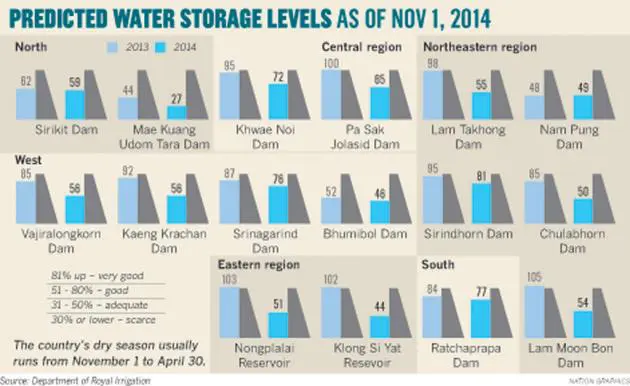
The Royal Irrigation Department has predicted that as of November 1 this year, water levels in Bhumibol Dam would have reached only 46 per cent of its total capacity – down from 52 per cent a year earlier. Similar situations are also expected at other major dams.
For example, the water volume at the Kwai Noi Dam will be around 72 per cent of its total capacity, down from 95 per cent.
At the Sirikit Dam, water volume will be around 59 per cent – down from 62 per cent.
At the Pasak Jolasid Dam, volume will be at 65 per cent – down from 100 per cent.
Lertchai blamed the water-shortage threat on inadequate rainfall, something that would threaten crops in many parts of the 131 million rai of farmland around the country.
To cope with the imminent threat, Lertchai said joint committees had been established to help farmers plan what to grow, in what amount, and when.
On many industrial estates in the East, Lertchai said his department had already drawn up water-management plans and there should be enough water supply to support industries during the coming dry season.
Meanwhile, Natthe Nhummak of the Phitsanulok Irrigation Office said the province might encounter water shortage because of the low levels of the Bhumibol and Sirikit Dams.
Bhumibol Dam’s water volume are now at the lowest levels in 10 years.
Water discharge from both dams play a key role in driving agriculture in the lower North region and Central region, he said.
“In the past year, we have asked farmers to cooperate by reducing the size of double-crop rice growing to 4 million rai. However, there are now 9 million rai of double-crop plots, which require more water,” he said.
As a result, only a low volume of water was discharged to Bangkok through the Chao Phraya River, which is likely to cause brackish water in February-March.
He urged farmers to reduce double-rice crop paddy fields and instead plant other crops that rely on less on water.
Natthe also commented that the RID should develop a water management strategy to ensure that there is adequate water for agricultural purposes until the next rainy season.
Surat SngunSab, a farmer in Phitsanulok, felt that the drought would not be severe and there would be enough water for agriculture.
“There are rice paddies in the non-irrigation zone using 44 pumping stations that will help us overcome the water shortage problem,” he said.
However, Thongdang Noirung, a farmer from Phrom Piram, voiced concern that there wouldn’t be enough water for double-rice crop paddy fields after the RID cancelled the discharge of water for in-season rice paddys.
“This will affect Phrom Piram district, which depends on water for 12,000 rai of rice paddy,” he said.
