
Free anti-retrovirals for all with HIV


Play
Move aims to limit spread of disease, as only 54% sufferers were able to get drugs previously, deputy minister says
Beginning this month, the government is offering free anti-retroviral drugs to HIV-positive people regardless of their CD4 count (a type of white blood cell).
The move is aimed at reducing the threat of Aids, as some research suggests that if people get the drug within one month of being diagnosed with HIV and continue taking anti-retroviral drugs, their HIV infection can drop so low that they will not spread the disease further. Fatality rates related to HIV could also be cut as a result.
The timely use of anti-retroviral drugs also mean that HIV-positive people have a greater chance of maintaining their health and living a relatively normal life.
Before this, patients in Thailand received anti-retroviral drugs only when they had fewer than 350 CD4s in one cubic millimetre of blood through the universal healthcare scheme. Once a person is infected with HIV, the virus starts to destroy the CD4 cells, which makes the person more vulnerable to opportunistic infections.
Anti-retroviral drugs were included as part of the universal healthcare scheme, which covers millions of Thais, from October 1, 2005.
Earlier this week, Deputy Public Health Minister Somsak Chunharas said that anti-retroviral drugs only reached about 54 per cent of all HIV-positive people in Thailand.
“So, it has become one of the government’s policies to prescribe anti-retroviral drugs regardless of the CD4 level,” he said, adding that free prescriptions for anti-retroviral drugs would be made through both the universal healthcare scheme and the social security scheme.
Nimit Tien-udom, director of Aids Access Foundation, welcomed the move. However, he urged the government and public to do more to improve the fate of people living with Aids/HIV.
“We need to try harder in ending or at least reducing the stigmatisation of and discrimination against those living with Aids/HIV,” he said.
“What is the point of helping kids who were born with HIV, if they will eventually face hatred and discrimination when they grow up,” he said.
It was hard to convince those kids that they can study, work and live a normal life in the face of widespread discrimination, he said.
“When these kids grow up and graduate, many cannot get a job because companies require them to undergo blood tests and refuse to recruit them,” Nimit explained.
So, telling the public about HIV/Aids and making people accept and support these people was still needed, he said.
A woman who has lived with HIV for the past 20 years said that when people found out that she and her husband were infected, people started to avoid them.
“They stopped coming to my clothes shop,” she said, adding that even her relatives felt uncomfortable with her though they did try to be supportive.
“It’s because they lack true knowledge about the disease,” she said.
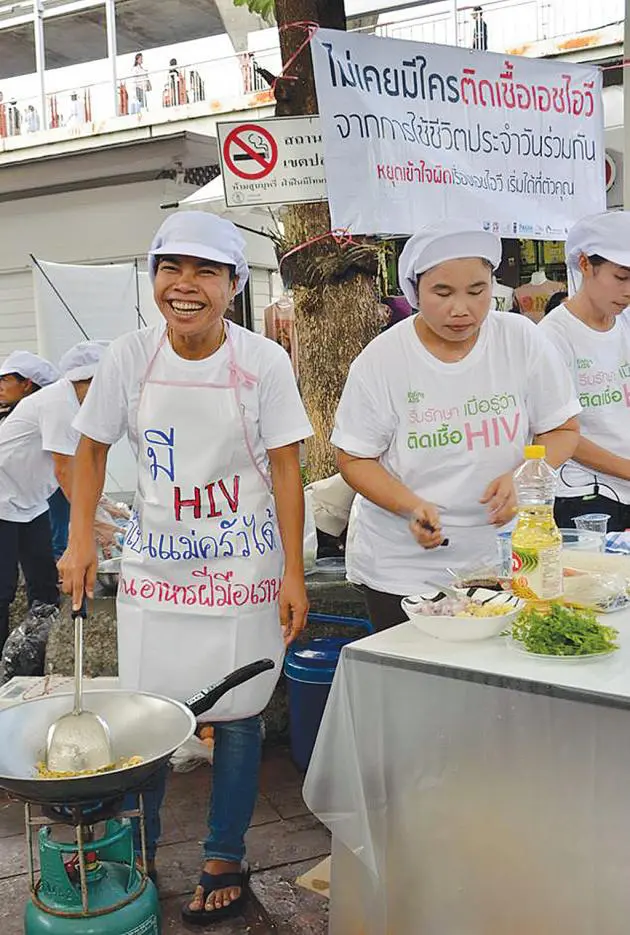
Apiwat Kwangkaew, who leads the Thai Network of People Living With HIV/Aids, said the public should know that the disease cannot be passed to others simply through general contact or eating food cooked or prepared by a person with HIV.
