
Plans for people power spelled out


Play
Council for Reform says they want to propose ideas for new constitution
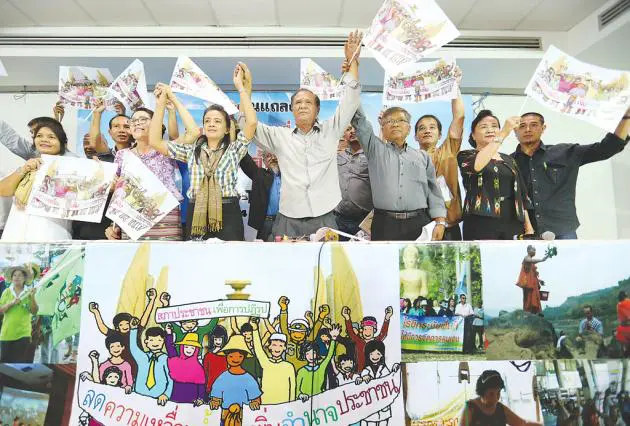
The newly established People’s Council for Reform has set its key agenda to tackle social inequality and increase people’s power by having the council included in the new constitution to act as another branch to check and balance power.
Charchai Luengcharoen said such a move would promote democracy, encourage people’s participation and strengthen communities. The council’s key responsibility would be to regulate administrative power from national to local levels.
The council held a press conference yesterday to announce its establishment, saying it was based on cooperation between the citizen sector and various organisations, such as community groups, civil society, academics, and businessmen and over 30 farmers’ networks.
Council representatives Jinda Boonyajun and Lawun Ngamchuen said it would act as a networking body to coordinate between citizens and other organisations. The aim was to consider a reform proposal and to ensure the new constitution is drafted in a democratic manner.
People’s representatives from all regions of the country offered their visions of national reform.
Bumrung Kayotha, Northeast region representative, said the 250 members of the National Reform Council could not consider all social issues in the country. Hence there should be a stage where they could listen to people’s ideas. He suggested the government could help farmers by investing in research and development of tools that could increase productivity and improve marketing.
Bumrung also proposed that the government focus on strengthening communities, as strong citizen groups could help regulate against corruption.
Maithree Jongkraijak, a southern representative, said people in the South needed more land security, and rights to manage their properties. He also backed the idea that the People’s Council should be included in the new constitution to act as another branch to regulate and propose ideas.
Eastern region representative Jumroon Suaydee said people should be given power to govern themselves. The past 30 years had proved that central government failed to live up to its promise to transform the region into a special economic area.
He proposed that people in the East should solve their own problems – given authority and legitimacy to do so without having to follow the reform roadmap designed by the National Council for Peace and Order (NCPO).
Jumroon’s rejection of NCPO’s reform road map joined a rising number of dissidents, especially from the Northeast.
The “Isaan People’s Network” (Northeast People’s Network) who did not join the reform council, said they rejected the legitimacy of the junta altogether. Hence they rejected the mechanism engineered by the coupmakers including Cabinet, NRC and legislative assembly.
