
Moves against land encroachers 'flawed'


Play
NHRC SAYS RIGHTS TO COMMUNITY LAND AREAS IGNORED; 'MOST VICTIMS POOR'
AFTER SIX MONTHS in power, the National Council for Peace and Order has nothing to boast about in regard to its promise to solve land and natural resource problems.
There has been no big case involving action against grabs of forestland.
The people who have been pushed out of forest zones are mostly the poor, whose families lived there well before their communities were declared parts of national parks or forest reserves.
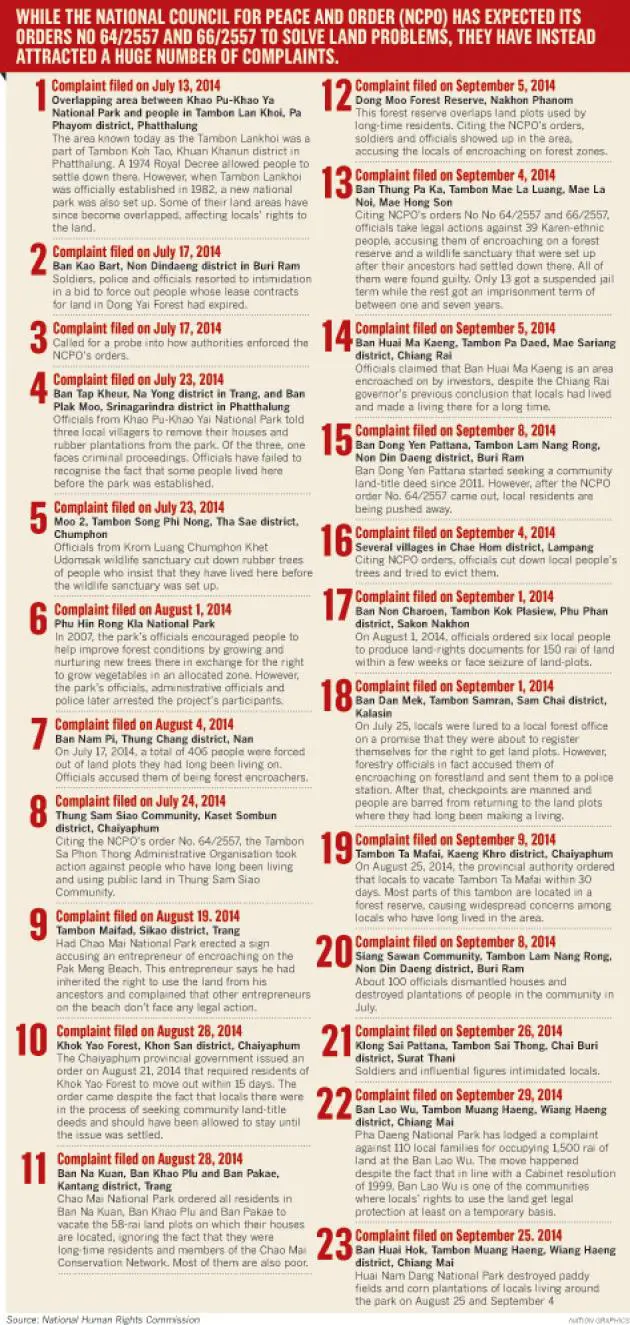
Armed with NCPO orders No. 64/2557, which centres on the suppression of deforestation activities, and No. 66/2557, which relates to the appointment of additional agencies that engage in anti-deforestation actions, soldiers, police and agency officials have used various methods to drive locals away.
Sometimes, officials have resorted to intimidation. Sometimes, they have even destroyed plantations and paddy fields.
Dozens of people in Mae Hong Son’s Mae La Noi district faced legal action in recent months on charges of forest encroachment.
In addition to those getting suspended jail terms, 26 people were sentenced to jail terms of between one year and seven years.
“We have received more than 30 complaints from people affected by the NCPO orders No. 64 and 66,” Niran Pitakwatchara, of the National Human Rights Commission, said.
He said the orders had in effect caused grave concern for many people.
“These people are the ones who have been fighting for their community rights and for community land-title deeds for decades, when suddenly soldiers showed up to push them away,” Niran said.
He said their rights should not be ignored given they or their families had been living on the disputed land before the Forest Reserve Act was promulgated.
Niran chairs the NHRC subcommittee on community rights and also the NHRC subcommittee on human rights related to land and forest.
In response to the complaints, his subcommittees have summoned representatives from implementation agencies to explain what has happened.
“The officials have tried to say that they acted against investors but it’s poor people who have come to us,” Niran said.
The rights commissioner is |concerned that relevant authorities are going to use the NCPO orders to |pursue the ambitious goal under the national forest master plan that aims to ensure some 40 million rai (15.8 million acres) of forestland in Thailand.
Under the NCPO orders, and with martial law imposed on most parts of the country, soldiers have helped evict alleged forest encroachers.
Prayong Doklamyai, an adviser to the Network for Thailand’s Land Reform, is concerned the crackdown under the NCPO’s supervision might not be the solution.
“On the contrary, it may trigger problems because relevant agencies have clearly failed to coordinate with local people in recent months,” he said.
He said land problems had existed for a long time and efforts to solve them required the co-operation of all sectors.
According to Prayong, after the NCPO came to power it assigned the Internal Security Operations Command and the Ministry of Natural Resources and Environment to draw up a master plan to protect forestland.
Although the master plan also takes into account information from a plan prepared by Kasetsart University’s Faculty of Forestry, it is far from being well rounded.
“This master plan needs a review,” Prayong insisted.
He said in essence, the plan still focused on old methods of trying to reclaim forest areas from small people. These methods had proved ineffective over many decades.
‘Large number adversely affected’
“This master plan has adversely affected a large number of people. If things go on like this, there will be some impact on NCPO works in the future,” Prayong warned.
Niran said the deployment of soldiers to drive off long-time residents in forest zones would never win the acceptance of locals.
The NHRC commissioner also questioned the military’s presence when stakeholders, including members of the public, joined a public hearing held as part of an environmental impact assessment for a Krabi-based power plant project, as well as various other meetings on environmental issues.
Although soldiers did not disrupt the process, those present did not feel the process was friendly, he said.
“Such a move may aggravate conflicts, not promote reconciliation,” he warned.
Niran does not buy the NCPO idea that people affected by its orders can petition relevant authorities for help and propose land-management |models to the National Reform Council.
“How can people wait that long? They are in trouble now but the NRC is still in the process of gathering opinion,” he said.
