
Mixed feelings over junta's start


Play
BUSINESS HAPPY BUT FEARS VOICED THAT REFORM PROCESS IS BEING STIFLED BY MARTIAL LAW AND RIGHTS BEING TRAMPLED ON
SIX MONTHS after the coup on May 22 some positive changes have been noticed, although critics and observers say the military leaders have not done enough to promote an atmosphere suitable for national reform.
Those interviewed by The Nation gave mixed reactions when asked how satisfied they were with Thailand in the past six months under a military junta. Responses ranged from “not very satisfied at all” to “satisfied with the evident peace and certain government policies”.
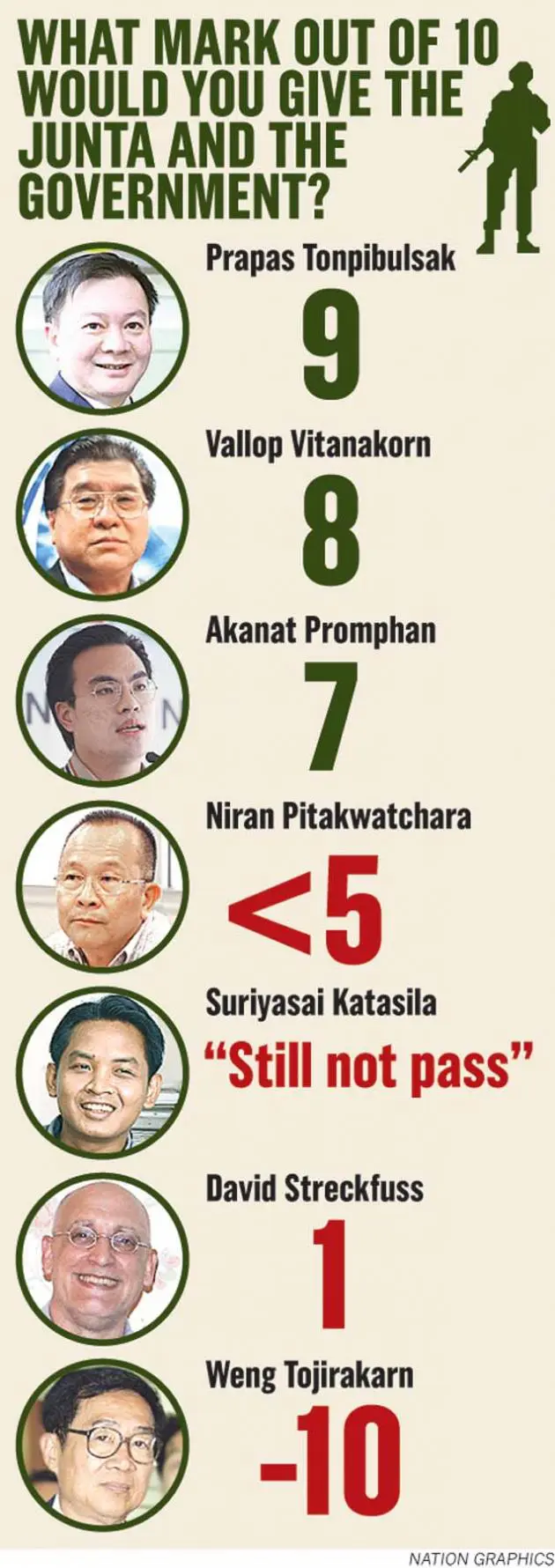
Scores for performance of the junta and the Prayut Chan-o-cha government ranged widely, from minus 10 to 9 out of 10.
Niran Pitakwatchara, a member of the National Human Rights Commission in charge of political and civil rights, said the most-liked policy for him was that the National Council for Peace and Order (NCPO) had managed to use military power to end the killing of civilians at demonstrations. However, he said there had been an increase in human rights violations.
“The remaining hope is that Thai political development in the civil sector is still strong and spread throughout the country,” he said.
As for a score for the junta, Niran said: “Human rights and democracy are on the retreat. It’s not down to zero out of 10 yet – but it’s definitely less than five.”
His life had not changed much since the coup. “My personal life is the same but some people have been alienated,” he said.
Thailand Reform Institute (TRI) director Suriyasai Katasila said this government still had not produced any tangible policies, especially in the area of governing the country.
“I am still not impressed – especially in the business area – that we still are not developing as much [as expected]... “Rubber and rice, including their price issues, are still not managed properly, which could be seen as poor people still struggling and ... neglected by the government,” he said.
However, he praised the junta for maintaining peace between the conflicting sides. “Earlier Thailand faced a violence problem. The NCPO helped this country on eradicating dangerous situations towards the people,” he said.
Asked to evaluate a score of the junta’s government, Suriyasai said “overall this government still doesn’t pass, moreover they failed on the economy and people’s living standards problems. I would like to urge them to prove themselves as soon as possible for the time they have left.”
‘Cabinet needs time to prove itself’
He said perhaps it was still too early to evaluate the Cabinet’s working and it should be given more time to prove itself after only several months.
“In addition, the NCPO performs very well on national security, which might be the only thing this government was doing [well],” Suriyasai said.
Asked for his favourite policies or least favourite, he replied the best policy was when the junta came up with a deal with armed groups. However, they had to proceed continuously to prevent further movements that might involve the military.
“The least favourite is surely how the junta government sealed people’s mouths without identifying who had good intentions and those who didn’t. The public wanted to propose their ideas on national reform and the NCPO shut them down, which could be considered as suffocating our own people,” he said.
Suriyasai said he understood the junta was focusing on national stability and reconciliation, preventing any conflict from emerging. But for political observers who wanted to propose their plans on reformation, the junta in return shut them down by claiming the need for martial law, which was inappropriate.
Signs of dissatisfaction and opposition against the coup were still evident. Five students protested against the coup when Prime Minister Prayut Chan-o-cha visited Khon Kaen last week. And a few students flashed a three-finger salute at some Bangkok cinemas where the new Hunger Games movie sequel was being screened.
David Streckfuss, an independent scholar residing in Thailand, said he was “not very satisfied at all” with life under the junta.
“The NCPO has managed to create something of a common cause between red-leaning activists and yellow-leaning community rights advocates over the issue of martial law and human rights,” he said.
When asked to score the junta and the government, Streckfuss replied: “1 out of 10, but negative scores also possible.”
He added it was difficult to give the administration any score at all “because for the vast majority of its time the NCPO has concerned itself with securing its own power, creating a framework for eternal control, and clamping down on those who think differently”.
He also complained about the human rights situation. “It is rather dire. The number of new cases of lese majeste and those criticising the regime is rising.”
‘No chance of lasting reforms’
When asked about his favourite policy and least favourite under the junta, Streckfuss said: “My favourite policy to lampoon is the regime's desperate attempts to market martial-law tourism.”
He said that his “least favourite policy” has to do with the junta’s reform efforts. “The structure it has laid out for ‘reform’ and a new constitution appears to be perfectly designed for disaster. There’s simply no chance of lasting reforms or a new charter conceived under martial law,” he said.
Gothom Arya, director of Mahidol University’s Peace Studies and Development Centre, said he only had a subjective evaluation of this junta government, because he insisted from the start that he personally had a negative opinion towards the government.
“I insisted from the beginning I had my prejudices towards the government; moreover I do not like to be limited on the freedom aspect and see others suppressed as well,” he said.
Gothom said he was not pleased with the way the government solved problems with a top-down approach. This meant heads of agencies always dictated to lower agencies, and thus limited their rights and freedom, and give orders to related agencies.
“I believe that many policies the junta government proceeded with, such as national security and reconciliation, are not performing as well as they should,” he said.
As for martial law, Gothom said that the world now views Thailand as being not in a normal situation. And this was leading to uncertainty among people in charge of a law that affects everyone in the country.
‘Like ghost of Sarit is haunting me’
Moreover, he rejected giving a score to this military government, saying he insisted he never made such an evaluation with a score, but had a clear standing on subjective evaluation.
He said although his personal life was not impacted on so much by this government, the problem of government intervening in his works was always there, which is usual for his area of work.
Weng Tojirakarn, a Pheu Thai Party politician and leader of the red-shirt United Front for Democracy against Dictatorship (UDD), said he “can’t be satisfied living under martial law and under the current provisional charter”.
He added that he was particularly dissatisfied with Article 44 in the post-coup charter, which granted the junta absolute power to override all three branches of the state.
“It’s hard for me to meet with others and exchange views for fear of affecting the government and the military,” he said.
To give a score on the junta, he said, “I have to give it a score of minus 10 because I feel like the ghost of Sarit is haunting me.” He was referring to Field Marshal Sarit Thanarat, the late dictatorial leader of the late 1950s and early 1960s.
“No democracy can be created out of dictatorship and I fear that what we’re seeing is a new elite-run system where freedom is limited,” he said.
For him, the most-liked policy was when the military regime managed to pay money to farmers who’d joined the Yingluck Shinawatra administration’s rice pledging scheme. The most disliked policy was martial law and Article 44.
Akanat Promphan, spokesman for the People's Democratic Reform Committee (PDRC), thought the junta was sincere about maintaining stability and promoting reform. He said the PDRC was satisfied with the junta helping to push for reform.
“We can see that the NCPO is sincere in its determination to make the country more stable, but still we cannot expect anything much at this point,” he said.
When asked if his life had changed, the young politician said: “It sure changes. Before, we used to rally or gather, marching on foot and calling for national reform. But now we’ve changed these movements to create a foundation which also helps propose reformation to the government.”
Business sector happy
To score the junta and the Prayut administration, Akanat said, “If five is a pass, I give this government a bit higher than half, which is seven.”
Prapas Tonpibulsak, chief investment officer of Krungsri Asset Management, said he gave a 9 out of 10 score to the Prayut government’s six-month administrative performance on economic affairs as it had focused more on economic structural change in medium to long term than short term.
Vallop Vitanakorn, vice chairman of the Federation of Thai Industries, gave 8 out of 10 for the government’s economic performance. It had tried to introduce stimulus measures to spur the economy. The federation and private sector knew this was difficult amid a sluggish world economy.
“I am satisfied with their economic performance despite the delay in the stimulus package. The private sector understands that the delay in its tangibility was caused by the buying and hiring process, since such a process required transparency and this government was trying to make it as transparent as it possibly could.
“The economy would have been worse if the government had not come up with stimulus measures,” he said.
He expected government buying – and the hiring process of its stimulus package – to be complete by next month and capital should enter the economy by the first quarter next year.
