
Academics urge CDC to seek public participation


Play
Borwornsak says charter drafters willing to consider all proposals
Academics have urged the Constitution Drafting Committee to create effective mechanisms for public engagement when deciding and finalising reform ideas that will be drafted into the constitution.
They also warned the public not to overemphasise reform proposals presented by the National Reform Council, as many of the proposals may not be actualised.
The CDC is expected to begin the charter drafting process when it receives the NRC’s proposals today.
Thammasat University political scientist Attasit Pankaew said that what was being reported in media in relation to reform was merely individual opinions – reformers had been “throwing rocks to test the water”.
However, he said these rocks “will have to be thrown back to the people” through public participation and engagement such as forums and seminars so the CDC could hear what the people thought.
“The NRC’s duty is to accumulate ideas and submit them to the charter drafters; however it is the CDC who will have the final say in drafting the new constitution.”
Political scientist Sirote Klampaiboon said that certain individuals such as CDC chairman Borwornsak Uwanno and Deputy Prime Minister Wissanu Krea-ngam hold significant influence and power to decide what would be drafted in the new constitution.
In fact, NRC is an institution with the least power and influence to push through their agenda, in comparison with other institutions since the post-May 22 coup.
“The NRC is not the deciding body,” Sirote said. “The main purpose of the NRC is only to create a feeling of public participation.
“The ones who have more deciding power and influence are the National Council for Peace and Order, the National Legislative Assembly, and the CDC,” Sirote said.
He said the NRC voices were “weak” because they were lacking the “popular base”, meaning NRC proposals were merely “personal opinion”.
The NRC also appeared to lack unity, which hindered its negotiating power with other institutions such as the NCPO, the NLA and the CDC.
The NRC’s three-day meeting to debate and finalise its reform proposals ended on Wednesday.
Borwornsak said after the NRC meeting that charter drafters were willing to consider all NRC opinions and proposals submitted to the CDC.
He said all NRC members were welcome to attend the charter deliberation process. He urged the members not to be critical.
In a few reform areas during the NRC meeting, a large number of members spoke, including 39 for the political reform debate.
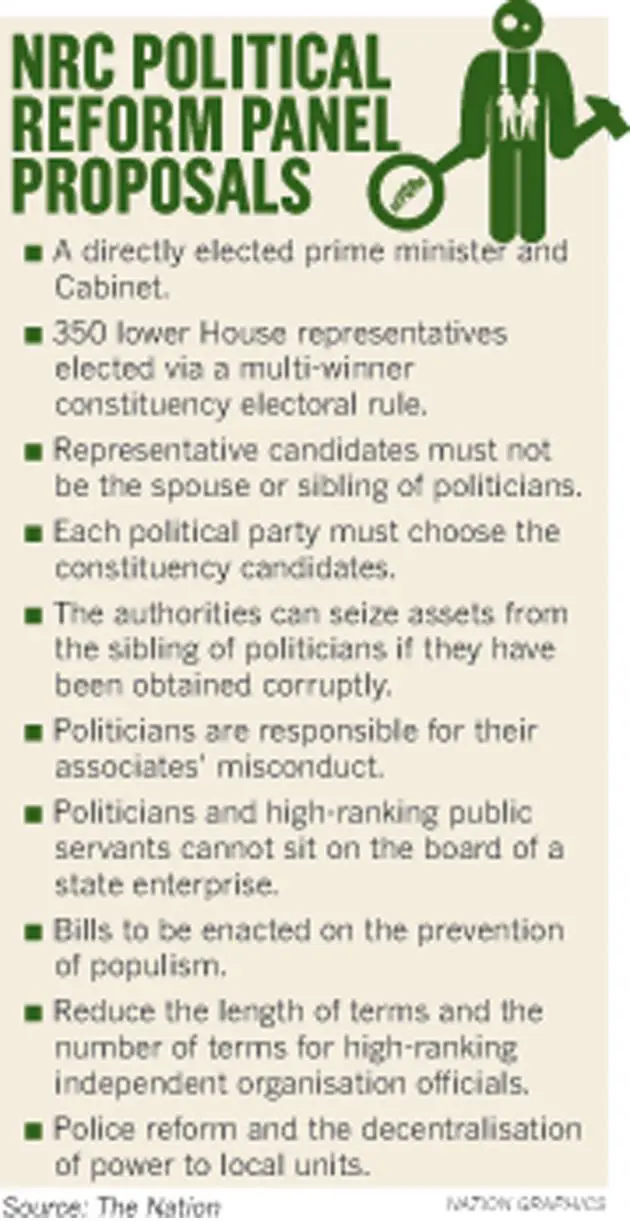
During the debates, some members clearly stated their stance against certain proposals, especially in relation to the direct election of the prime minister and cabinet members.
Borwornsak said political reform was at the heart of all national reform areas because bad politics could lead to bad judgement at a national level. Hence, political reform should not to be taken lightly.
On the much-debated NRC proposal to have a directly elected premier and cabinet, the CDC president said he opposed the idea because there were many potential risks that such a system could bring to society.
For example, it could worsen the electoral fraud issue. With the proposed system the winner takes all, enabling the winner to take control of a stable and powerful executive branch.
That would result in more fierce electoral competition and consequently more money being invested in vote buying.
He said another concern was that the premier and cabinet members would become very powerful because they could claim democratic legitimacy.
From past experience, there had been political intervention in independent organisations and the media by the government. Therefore, a stronger government was likely to worsen this problem.
Borwornsak said the proposal came with a “fundamental risk”.
A directly elected PM and cabinet would be even more powerful than the US president because it would allow the executive to propose bills and the budget.
He said if the premier and the cabinet controlled Parliament, the checks-and-balances system would become ineffective, and a political stalemate could occur if Parliament were to be controlled by the opposition.
