
Parties to escape dissolution for 'overthrow of democracy'


Play
BUT INDIVIDUALS WOULD BE PUNISHED FOR ANY UNDEMOCRATIC POWER GRAB: CDC
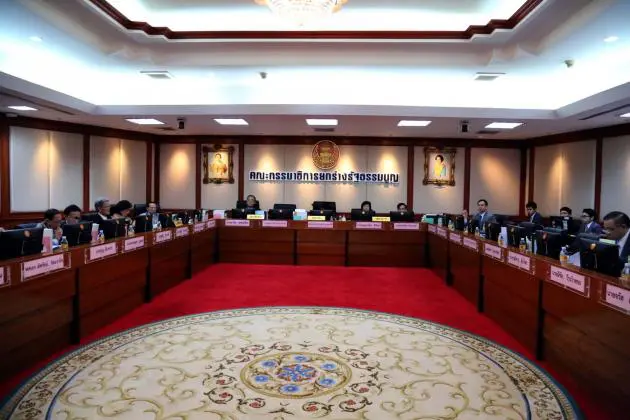
INDIVIDUALS – not their political parties or organisation – who plot to overthrow a democratic regime or seek power through undemocratic means would be punished by the new constitution, drafters proposed yesterday.
In a clause to protect the constitution, Article 68 of the draft charter forbids an overthrow of the democratic system with the monarch as the head of state.
Citizens will also have the right under the new constitution to petition the Constitutional Court to halt any action deemed as an attempt to obtain political power through unconstitutional means.
Article 68 of defunct 2007 Constitution says “in the case where the Constitutional Court makes a decision compelling the political party to cease to commit the act under paragraph two, the Constitutional Court may order the dissolution of such political party.”
The severity of the punishment is yet to be decided, but will be stipulated later in an organic law.
“A person cannot use their rights in a way that would cause the overthrow of the democratic system under the monarchy under this constitution, or to obtain executive power in governing the country by methods not covered in this constitution,” the first part of the draft charter article stipulates.
“In the case that a person’s actions fit the criteria of the first section, whoever acknowledges the act could file a complaint to the Constitutional Court for final arbitration. In this regard, the Constitutional Court has the authority to order the halt of such action and give other orders … However, the exercise of this right must not affect the criminal case for the accused,” the |second section of the proposed article states.
It seems that Article 68 could be used against anyone who calls for changing the democratic system to that of a republic, and the name of one prominent academic who is regarded as being pro-republican was mentioned during yesterday’s CDC deliberations. As for the latter part of the first section of the article, it is intended to thwart any future unlawful seizure of political power, such as through a military coup. Meanwhile, one CDC member said giving the Constitutional Court the authority to intervene in cases against an accused would strengthen the charter, and also protect it.
The same member also cited the case of Germany in 1919, when there was a parliamentary vote to change executive power to a dictatorial system, giving rise to Nazism – and eventually the Second World War. Germany had no constitutional protection at that time against changes to its political system, the committee was told.
Another reason to support the draft article is that it could also promote a closer bond with citizens, who would be given a role to protect the constitution – the Kingdom’s 20th – even though it is considered the highest national law, the CDC member explained.
The article aims to deter those who want to change the political system as well as those who want to illegally seize power, the charter-drafter added.
Furthermore, the committee has come to the conclusion that dissolving political parties for the crime of trying the overthrow the political system is not right, as the individuals involved should be taken to court and punished, instead.
Such a penalty on political parties existed under the now-abrogated 2007 charter, its exclusion being made in order to bring the constitution more in line with the international norm, it was said.
The CDC member reasoned that dissolving a political party would not promote a better balance for the political system, but would in fact stall the country’s development and lead to severe social and political disputes.
The committee resolved to draft Article 68 in accordance with the suggestions discussed.
Questions were raised, however, as to where the line should be drawn and whether or not exercising academic freedom to discuss and debate a republic system should be considered as an attempt to overthrow the system.
