
Total household garbage cut


Play
PCD helps slash yearly amount by 2 million tonnes
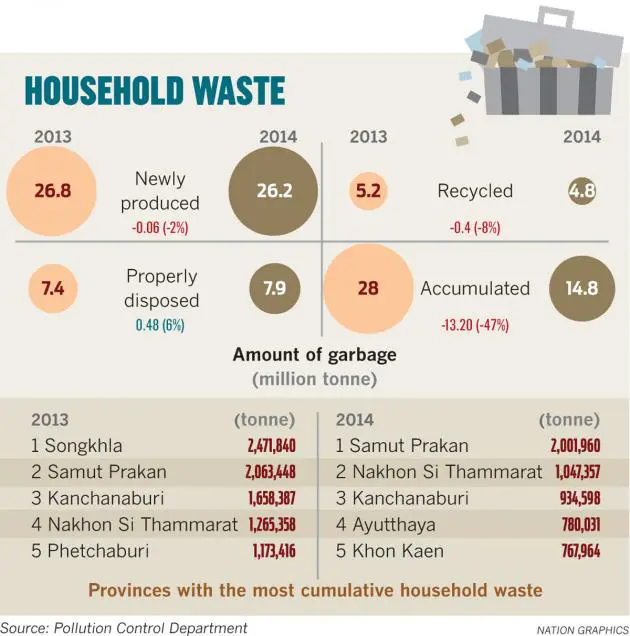
THE total amount of household garbage in Thailand shrank from 28.2 million tonnes in 2013 to 26.2 million tonnes last year, Pollution Control Department (PCD) chief Wichien Jungrungreung said yesterday.
Samut Prakan province had the most cumulative garbage at 2.01 million tonnes last year, followed by Nakhon Si Thammarat with 1.04 million tonnes, Kanchanaburi (943,598 tonnes), Ayutthaya (780,013 tonnes) and Khon Kaen (767,976 tonnes).
Songkhla, which generated the most garbage in 2013 with 2.4 million tonnes, had improved and ranked 30th on the list for last year.
Thailand wants to eliminate as much garbage as possible by 2016, and Wichien said a new draft law would be proposed to the National Legislative Assembly in May to be propel the policy forward.
He also raised a concern over the disposal of solar cells and computer tablets. Thailand last year imported 3.2 million solar cells for the government’s renewable energy scheme while 1.4 million computer tablets that the Education Ministry had provided to pupils could also pose a disposal challenge this year.
In 2013, a report on the 28 million tonnes of garbage led to it becoming a national issue. A subsequent PCD road map for waste management, which was approved by Cabinet last August, led to concerted efforts to lower garbage last year.
Wichien said the 26.3 million tonnes of newly produced household garbage – or 1.11kg per person per day last year – was down by 0.6 million tonnes from the previous year.
He said 14.7 million tonnes of waste were disposed at 2,450 dump sites, with about half of that eradicated properly, he added.
Under the road map, 246 clusters (small, medium and large sizes according to local administrative bodies’ trash amounts and collection radiuses) were responsible for garbage disposal and large clusters had private sector investment in garbage-fuelled power plants, he said.
Out of 32 potential areas for such power plants, two (in Phuket and Songkhla) were now up and running, while other three (in Khon Kaen, Phatthalung and Bangkok) were under construction, he said.
Smaller-sized clusters focused on trash separation to promote recycling and reducing the actual amount of trash to dispose of.
As last year, there were also 98 model locations for the whole process of garbage separation and proper disposal, he added.
For 2.69 million tonnes of hazardous waste last year, Thailand had 83 centres to take such waste – about 77 per cent of which came from the industrial sector and 21 per cent from communities, he said.
