
Call for a referendum


Play
Energy Ministry says looming crisis is reason why concessions must go ahead
THE People’s Network for Energy Reform Opponents, which opposes plans for new oil and gas exploration concessions, has suggested a national referendum be held to resolve an escalating conflict over the issue.
The idea was one of three proposals for the government to consider before going ahead with a further round of concessions.
Meanwhile, representatives nominated by the public sector say a looming energy crisis is the reason why the bidding process should go ahead as soon as possible.
The Energy Ministry has extended the deadline for drilling exploration bids from February 18 to March 16 pending further discussion.
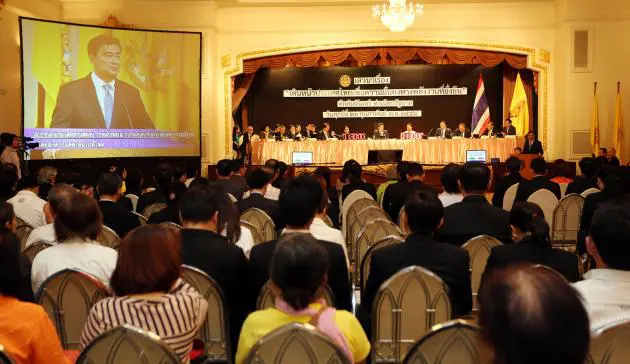
The two sides agreed at a forum yesterday that both the petroleum exploration concession and production sharing contract (PSC) systems had their benefits, and that there were flaws in the current Petroleum Act that should be amended.
However, they were unable to agree on whether the government should continue with the 21st round of bidding next month, or delay it by two to three years to allow for regulatory reform.
“Representatives from the public sector already admitted that there are flaws surrounding the current Petroleum Act that have to be corrected, so why not amend it now? I have proposed a national referendum or a poll, which would specifically ask whether or not the Petroleum Act should be amended to make it more transparent, before the 21st round of concessions,” said former finance minister Thirachai Phuvanatnaranubala, who represented “the people’s” side of the argument at the forum.
National Reform Council member Rosana Tositrakul proposed an executive decree for reforming the Petroleum Act, which she said would lessen the length of time needed to reform the regulations within the current Act.
Academic ML Kornkasiwat Kasemsri said the government should spend around Bt5 billion to conduct its own initial exploration, which would provide bidders with more information to assess their risks.
He argued that this would attract more bidders and support healthy competition.
The People’s Network for Energy Reform also asked for a production sharing system to be included in the regulations of the Petroleum Act, to provide more options for future exploration of natural resources besides the concession system.
“Bt5 billion is only one per cent of the total value of [revenue from] petroleum in one year, and if the government was expecting to spend Bt900 billion on the water-management programme, how come it cannot spend this much to explore for natural resources in our country?” Rosana said.
Energy Ministry deputy permanent secretary Kurujit Nakornthap, who represented the public sector at the forum, said: “The public sector has already clarified today that some of the [perceived] flaws within the regulations of the Petroleum Act do not really exist and most, if not all, of them are tax regulations. But the People’s Network for Energy Reform cannot even show us today what kind of production sharing contract they really want.”
He said minor tax flaws in the regulations did not mean that the concession system should be replaced by a PSC (production sharing contract) system – the fact the country faces an energy crisis meant that it could not afford to wait any longer.
Any amendment to the regulations could be done in parallel with the exploration process, while there is no guarantee that any natural resources will be found from this round of exploration, he added.
The public-sector side said that 65 per cent of the petroleum discovered in Thailand was from the first round of exploration alone, while the proven reserves of natural gas found in the country would be depleted within seven years.
Meanwhile, neighbouring countries, especially Myanmar, are less likely to increase the amount of energy they export, since their economies are expanding, Kurujit said.
Kiatnakin Bank CEO Banyong Pongpanich, who supported the sale of PTT shares back in 2001, said he disagreed with a referendum on the issue since the arguments against the concession and regulatory flaws had already been clarified.
He told the forum that if no oil or gas were found after reserves ran out, the country would have to increase the amount of energy being imported, which could eventually increase the costs of logistics and electricity by around 30-40 per cent.Banyong is a member of the “super-board’ overseeing state enterprises.
Representatives from the public sector also said there were many risks – both financial and security – when it came to the exploration of natural resources, and the private sector had more expertise in this field. So, the private sector would have more chance of finding new resources.
The results of yesterday’s discussion will be presented to Prime Minister General Prayut Chan-o-cha, and then to the Cabinet.
Both sides agreed to form a joint committee to oversee the issues that were raised before coming up with solutions before the next deadline for petroleum exploration bids, on March 16.
