
In search of rural excellence


Play
INDIAN PARLIAMENTARIAN GAURAV GOGOI TALKS ABOUT HIS LOVE FOR THAILAND AND HOW HIS HOME STATE OF ASSAM CAN BENEFIT FROM THAI DEVELOPMENT PRACTICES
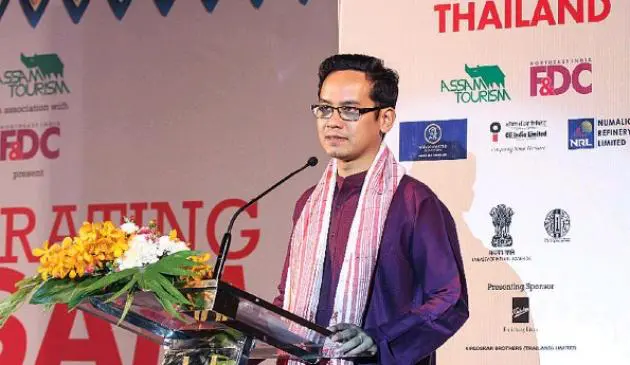
IN TOWN LAST week as a special guest at the “Celebrating Assam” event that opened the Festival of India in Thailand, Gaurav Gogoi, son of the chief minister of Assam and a wellknown parliamentarian in his own right, spoke of his admiration for Thailand, his father’s peace proposal and a range of other topics that touched both on politics and the upcoming Asean Economic Community.
The holder of a degree in electronics engineering, Gogoi headed to the US for his postgraduate degree in public administration. He did an internship at the UN before returning to his home state, and plunging into everything, from farming to publishing to politics. The active, articulate parliamentarian recently married a British climate-change expert, and counts reading, running and eating among his hobbies.
ASSAM IS ONE OF THE STATES IN INDIA WHERE THE INDIAN CONGRESS PARTY HAS BEEN POWER FOR A LONG TIME? WHY IS THAT?
My father Tarun Kumar Gogoi has long been a member of the Congress party, and has been re-elected chief minister of Assam on three occasions, making him the most successful chief minister to date. After several decades of militant insurgency in the state, which the central government tried to control through the standard military approach, my father realised that they were neglecting social stability and economic growth. He felt that good governance alone would convince the insurgents to align with the government. In 2001, he created a new peace model, focusing on infrastructure development, road connectivity, job opportunities, health and education. As a result of this, Assam, which had lagged behind the rest of the country in terms of growth for more than two decades, surged ahead in 2008.
WHAT ARE THE ADVANTAGES AND DISADVANTAGES OF BEING THE SON OF SUCH A SUCCESSFUL POLITICIAN?
The obvious advantage is that it was easier to connect with a large constituency of 1.4 million voters. The disadvantage is that thepeople want quick results.
COULD YOUR FATHER’S PEACE-MODEL WORK IN OTHER COUNTRIES THAT HAVE INSURGENCY PROBLEMS, LIKE SOUTHERN THAILAND?
Yes, it could. Thailand has a great deal in common with Assam. I admire it a lot, and want to learn from it. The country has achieved a high level of modernity, especially in areas like public infrastructure, and yet retains its cultural heritage. I would like Assam to emulate this.
HOW DO YOU SEE TIES BETWEEN THE TWO NATIONS DEVELOPING?
We now have direct flights between Assam’s capital city of Guwahati and Bangkok. The current Indian Ambassador to Thailand, Harsh Vardhan Shringla, envisions making Assam and the Northeast region of India a “bridge” between the two countries and I fully endorse this idea. We recently organised the Indo- Asean Car Rally that ended in Guwahati. And the Trilateral Asian Highway is making good progress.
WOULD THIS HELP ASSAM TO BECOME A KIND OF BUSINESS HUB?
Assam could well become a business hub, with its geographical proximity to countries like Bhutan, Bangladesh, and Myanmar that will soon become accessible by road. There would be plenty of scope to set up manufacturing units that could cater to the 40 million people of Northeast India. We are looking at many areas – food processing, electronic components and parts for high-end vehicles like Audi and Harley Davidson.
WHAT ABOUT THE POTENTIAL OF THE NEW ASEAN CONGLOMERATE?
Since 1991, India has focused on many of the Asean countries and has already signed several free trade agreements to facilitate the flow of goods. This can only increase in the years to come.
WE HEARD YOU SENT A FARMERS’ DELEGATION TO THAILAND. WHY?
I sent a group of 16 farmers recently to Thailand and they visited an agro-university, rice research institute and cooperative groups. After they returned, they set up pilot projects and demonstration-farms, which we supported. There’s a lot we can learn from Thailand about modern methods of paddy cultivation. Many say that agriculture is a dying business. That’s why I started a foundation to train 3,000 children about the entrepreneurship of farming. We also want to learn about aqua-culture, food processing, and agro-tourism from Thailand
IS IT TRUE THAT SOME OF THE TRIBES IN ASSAM HAVE THAI ANCESTORS?
That’s right. This includes my own Ahoum tribal community, some of whom speak the ‘ Tai’ dialect. Her Royal Highness Princess Maha Chakri Sirindhorn enjoyed meeting them during her visit a few years back. History tells us that our King Sukapha visited China and Thailand, before arriving in Assam and we are now further exploring our links with Thailand through research projects.
WHAT ARE THE OTHER SIMILARITIES WITH THAILAND?
We enjoy similar foods including sticky rice, pork, duck and poultry, That’s why I love Thai food so much, and plan to take home many Thai food pastes. Buddhism is also practised in Assam and we have many Buddhist stupas and monasteries, which might interest Thais.
WHAT ARE THE MAIN TOURIST ATTRACTIONS IN THE NORTHEAST REGION?
Nature, wildlife and birds are big attractions. We have started to develop many golf courses near the tea estates, where tourists can live in colonial bungalows or resort- style accommodation. We also have cruises on the Brahmaputra River. We plan to bring a group of Thai tour operators to Assam in the near future.
HOW IMPORTANT TO YOU IS THIS FESTIVAL OF INDIA IN THAILAND?
Very important, because the opening event was an excellent introduction to my home state and has created a buzz here. We hope we can build on that and draw many Thai tourists to Assam.
