
Crackdown on illegal fishing


Play
Govt might use Article 44 to put an end to IUU practices; four-point priority action plan devised
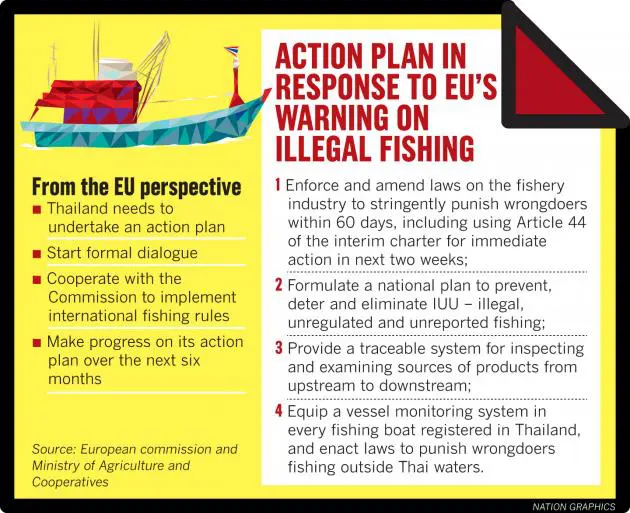
THE GOVERNMENT could resort to exercising its power under Article 44 of the interim charter to fast-track measures tackling illegal fishing practices with four priority action plans so as to avoid a potentially damaging ban on the export of Thai fishery products to the European Union.
The EU on Monday issued an official warning that it would slap the ban on Thailand if it did not take effective actions to solve the illegal, unreported and unregulated (IUU) fishing practices within the next six months.
Agriculture Minister Pitipong Phuengboon na Ayudhaya said: “We’ve worked hard with private enterprises to solve illegal fishing and labour problems but some measures take time. We will continue to enforce laws strictly and enact many measures to fix these problems.”
Labour Minister General Surasak Karnchanarat said there would be a high-powered meeting with the agriculture minister within the next two weeks to discuss measures to address the EU’s IUU warning, especially with regard to illegal labour and labour protection.
“The Labour Ministry will focus on the protection of workers in the fishery industry with emphasis on the requirement that workers must have contracts with their employers, must be at least 18 years old and must have at least 10 hours of rest per day or 77 hours of rest per week,” he said.
Fishing vessels must also meet the minimum requirement on amenities on board, while the Navy and Harbour Department will be jointly responsible for inspecting vessels in and outside coastal areas of 22 provinces in the country, Surasak said.
In addition, registration of migrant workers will improve labour protection in the Thai fishery industry and the government will learn from South Korea and the Philippines, which have been successful in meeting the EU’s requirements, according to the labour minister.
Agriculture Minister Pitipong said Thailand had heeded the EU’s earlier warning since last October, with work almost 50 per cent done. Now the government will complete the remaining components of the action plan within the next six months so that Thai exports could avoid the EU ban.
Thailand’s seafood exports to the 28-country market are worth about Bt30 billion a year.
Emergency regulation
Under the priority action plan, the minister said the government was considering enacting an emergencyregulation or regulations under Article 44 of the interim constitution within the next two weeks to empower officers to inspect fishing vessels and penalise illegal fishery enterprises or persons involved in illegal fishing.
Pitipong said that under Article 44, enforcement of fishery and related laws could be fast-tracked, whereas earlier it would take 60 days for new rules to be announced in the Royal Gazette before they became enforceable.
Under the new draft laws, the Thai government has decided on a steep increase in the fine for illegal fishing in overseas waters from Bt1 million to Bt30 million. Earlier, Thailand did not punish illegal fishing in overseas waters.
The government will also formulate the National Plan of Action to Prevent, Deter and Eliminate IUU Fishing (NPOA-IUU) to show its seriousness in tackling illegal fishing. In addition, there will be a traceability system to inspect and examine fishery products from upstream to downstream. It will train
and educate human resources involved in the industry about legal fishing.
The government will accelerate the process of equipping every fishing boat registered in Thailand with the Vessel Monitoring System, and enact a law to punish illegal fishing in and outside the Kingdom’s waters.
According to the Fishery Department, Thailand has 50,700 fishing boats. During the past year, until March 2015, the department issued fishing certificates to 12,455 boats. Of these, 4,243 fishing boats were certified from January to March this year.
To control and monitor any illegal fishing activity, the Fishery Department has also set up 18 Monitoring Control and Surveillance (MCS) units in the central office and regions. The government has also established 26 port-in-port-out units to control and inspect fishing boats at Thailand’s ports.
Thai Ambassador to Belgium Noppadon Gunavibool said the fishery industry needed to adjust and develop standards to meet the EU’s requirements.
He added that consumer confidence would be hurt because
many buyers were increasingly concerned about the environment, labour and human rights.
Chanintr Chalisarapong, president of the Thai Tuna Industry Association, said that taking into account the many measures launched by the Thai government in cooperation with private enterprises, Thailand’s fishery industry and exports should not be banned by the EU in the next six months.
The EU is one of the major export markets for tuna shipment, accounting for about 10 per cent of total shipments, valued at Bt12 billion a year.
Finance Minister Sommai Phasee warned of a huge impact on the fishery industry if the EU decided to impose a ban on Thai fishery products. However, he does not expect the EU to go ahead with full sanctions.
