
Thai-Japanese rail link to Chiang Mai follows China model


Play
CABINET TO CONSIDER AGREEMENT FOR HIGH-SPEED NETWORK BEFORE SIGNING MOC
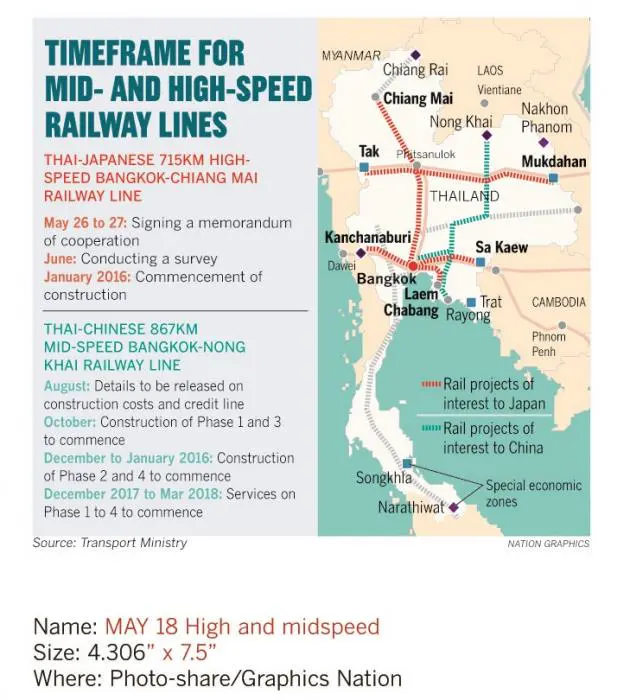
THE CABINET is expected to consider the draft of an agreement on the Thai-Japanese high-speed railway tomorrow ahead of the signing of a memorandum of cooperation on the Bangkok-Chiang Mai route in Tokyo next week.
The 715-kilometre Bangkok-Chiang Mai line is scheduled to open in 2019, Transport Minister Prajin Juntong told Nation Multimedia Group last week.
The railroad is part of Thailand’s strategic transport connectivity plan, linking the mass transit systems of big cities to small towns and neighbouring countries.
The Thai government is also cooperating with China on the development of the Bt400-billion Bangkok-Nong Khai route with medium-speed trains running at 160-180 kilometres per hour. The focus of this project is on the linkage of trade and services, and goods transportation in Asean.
The Thai-Japanese railway project, which would run trains at an average speed of 250kmh, would likely adopt the same model as the Thai-Chinese medium-speed railway project.
The project’s value is estimated at Bt400 billion, as it can be traded with a low loan rate.
“Japan said it welcomed the use of the same (cooperation) model as China,” Prajin said.
The government-to-government model employed the engineering, procurement and construction system and set up a joint steering committee.
Cooperation is also divided into three parts – civil works, system, and route and maintenance.
The Japanese government led by Shinzo Abe expressed its interest in a few routes during the official visit of Prime Minister Prayut Chan-o-cha to Japan in February. Recently, Japan decided on the Bangkok-Chiang Mai route.
Japan also offered a soft loan. The government hopes that the interest rate will not exceed 1.5 per cent.
As for the Kanchanaburi-Bangkok-Sa Kaeo railway, including a spur from Bangkok to Laem Chabang, which Japan is also interested in, Prajin said no new line would be constructed. Japan would just fill in missing links or make parts of the mostly single existing track into a double track – with a track width of one metre.
This line is under the government’s plan to develop double-track railways.
For the Bangkok-Nong Khai route, there was progress after both countries signed a memo of cooperation early this month.
Details on construction costs and a credit line with the loan rate would be known.
“If things are on track, we believe the construction of phases one (Bangkok - Kaeng Khoi) and three (Kaeng Khoi - Nakhon Ratchasima) will start in October and phases two (Kaeng Khoi - Map Ta Phut port) and four (Nakhon Ratchasima – Nong Khai) will start in December.
“Then, the services should be gradually available from December 2017 to March 2018,” he said.
The government was negotiating with China to cut the loan rate to 2.25 per cent from 2.5 per cent. This loan would be financed in connection with system work such as rolling stock and the signalling system, which would be based on Chinese technology.
For civil works, 70 per cent would be reserved for Thai construction companies, and a part of the funds would be raised via the public-private partnership scheme and infrastructure fund.
“I’m very okay with China’s reaction to what we move up in railway expansion. I feel China would like to carry out its commitment to the project,” he said.
Japan and China’s long “diplomatic relations” with Thailand and their strong commitment to the railway projects had convinced the government to go with G2G deals instead of open bidding, he said.
