
Drafters pressed on senators' selection


Play
PRESSURE continued to mount on Constitution Drafting Committee (CDC) members yesterday to amend the charter provision on the appointment of senators.
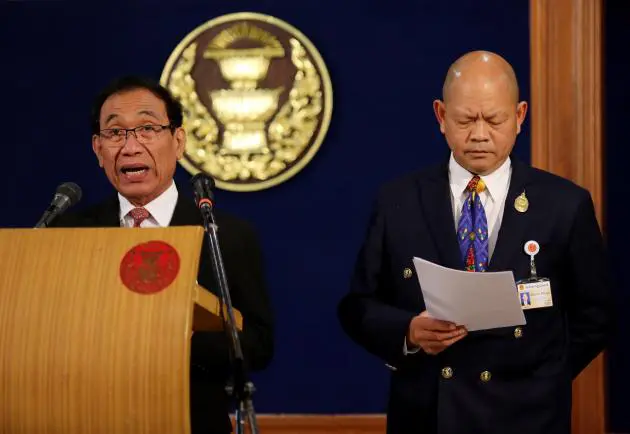
A group of NRC members led by Poldej Pinprateep met the charter drafters and pointed out that it was this one issue that drew their strongest opposition. Opposition to the appointment and scope of the power of senators – in Articles 121 and 174 – had been voiced from all sectors and key organisations of society, including the NRC political reform panel led by Sombat Thamrongthanyawong and, last week, the Cabinet.
The articles stipulate that senators should come from various “power groups” within society, professional associations and two representatives from each of the provincial elections province; however, Senate candidates must be “pre-selected” by a “Senate candidates’ selection panel”.
This has attracted wide-ranging criticism from the public as being anti-democratic.
CDC members are scheduled for daily meetings with NRC members this week until Saturday. It is a period when members of the two junta-appointed bodies are expected to exchange their contrasting views and come to a compromising solution.
The NRC members are led by Poldej and include Wiwat Salayakamthorn, Chermsak Pinthong and Wiriya Namsiripongphan, who had a formal meeting with CDC members yesterday. The gathering pointed to 71 articles they believed should be amended or removed from the draft charter.
Some articles they disagreed with have previously been opposed by the wider public, which means added pressure on the charter drafters to give ground for compromise.
Examples are Articles 181 and 182, which would give the prime minister power to dissolve Parliament if the majority of MPs did not give him of her a vote of confidence. Also he or she would have the power to push through important bills that MPs would have the choice to accept or face dissolution of Parliament.
The NRC’s public administration chairman and former vice president of the Supreme Administrative Court, Teerayut Lorlertrat, met with charter drafters in the afternoon, calling for 44 articles of the draft to be amended.
One of the articles the panel strongly opposed stipulated the establishment of a “regional development organisation” that had |a role in supporting the development of various provinces in each region.
The panel feared this would result in overlapping roles with local administrations whose members were elected. This would also be a waste of government money.
