
Forest land reclamation could spark war with the poor


Play
THE MAIN obstacle to protecting forest land has always been the reluctance of officials to take action against powerful encroachers, said Natural Resources and Environment Minister General Dapong Ratanasuwan.
“Officials are sometimes worried that they will get burned while carrying out their duty. So, some officials may prefer to turn a blind eye to encroachment cases,” he said.
“But since the current government came to power, I have stood by our officers to ensure they can do their duty without fear”.
“And we know which plantations belong to rich men, even when they use villagers as nominees,” Dapong said. “We will take action against the wealthy encroachers first.”
Officials’ vigorous execution of orders should be hailed in a country where forestland has been dwindling because of encroachment. But as the order seems to affect only individual rubber growers, the much-publicised policy of the National Council for Peace and Order (NCPO) to reclaim forestland may trigger a war with the poor.
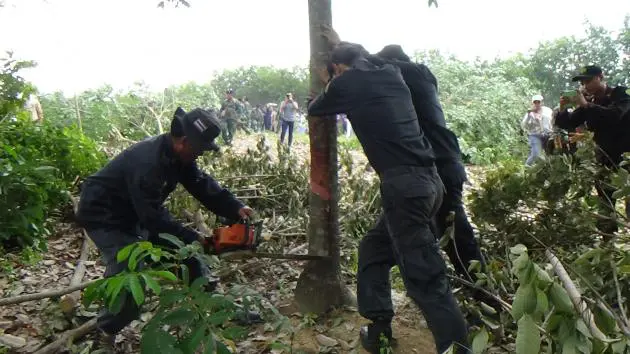
Late last month, the Network for the Sakon Nakhon Home of the Rightless held a ritual to restore the morale of Jantra Bangthong, 82, who lost her rubber plantation, the only source of income for her family, to the policy.
“I feel sad, pained and shaken to see soldiers and forestry officials mercilessly cut down all my rubber trees. How will I pay for my grandchildren’s education now?” she lamented.
To date, the NCPO-installed government has stood firm in its plan to tackle forest encroachment. The Royal Forest Department and also the Department of National Parks, Wildlife and Plant Conservation have proudly declared that their target is to reclaim 1.5 million rai of forestland from encroachment before the end of 2016.
Authorities, as a result, have actively erected signs that they will reclaim forestland in various provinces.
The authorities have also assured the public that they are targeting wealthy encroachers, or those encroaching on more than 30 rai of forestland. Still, in the eyes of some NGOs, government strategies cannot really implement reforestation successfully, because they end up hurting landless people.
Prayong Doklamyai from the People's Movement for a Just Society said the NCPO order to exempt the poor, landless people who lived in forest areas from evictions did not seem to carry weight now.
“I can’t ignore the fact that officials in charge of implementing the policy appear to ignore this specific order of the NCPO and take harsh action against poor people, so as to perpetuate evictions,” he said when asked to evaluate the NCPO performance earlier this year.
“The problem with the government’s efforts to tackle forest encroachment is that the authorities cannot separate the poor and landless people from the wealthy who encroach on forests, just like they can't separate an eel from a snake,” he said.
Several rights groups have tried to caution the authorities about their much-publicised campaign to give forestland back to the country.
They have emphasised that, no matter what, the government should avoid taking action that would adversely affect the landless and the vulnerable.
Many groups in Trang province have asked that the authorities postpone cutting down any rubber trees on suspicion of encroachment.
They believe the government, in particular, should be careful in handling rubber plantations that belonged to small-scale farmers.
Some critics can’t help feeling that the authorities are very swift in taking action against vulnerable encroachers, but not against those with money.
They considered cases involving big businesses in Nakhon Ratchasima province.
These enterprises have been accused of encroaching on forestland or agricultural-reform land for a long time, but the public hasn’t seen any action that is as decisive as cutting down rubber trees.
There were reports of encroachment by several resorts but action against them was less swift than the landless had experienced.
All eyes are now on the authorities’ future action. Without fair execution as promised by Dapong, the poor will feel they are subject to unfair treatment while the wealthy encroachers are spared.
Such feeling, if emerging and persistant, can turn explosive. It may trigger a war between the poor and the NCPO or its government.
