
Experts split over subs plan


Play
MANY BELIEVE THAILAND DOES NOT HAVE MARITIME ISSUES TO WARRANT BIG SPENDING ON SUBMARINES
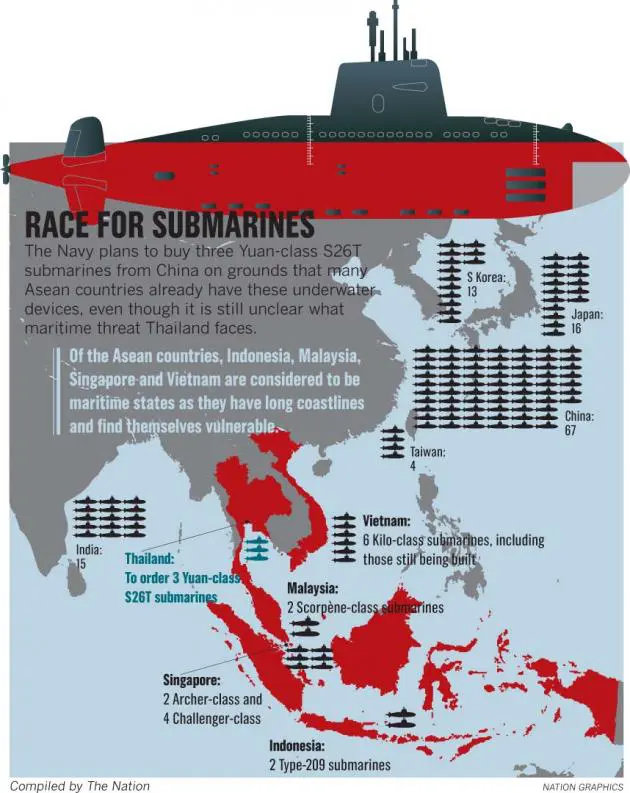
SOME SECURITY experts have questioned the prudence of the Navy’s proposal to purchase three Yuan-class submarines from China for Bt36 billion, asking whether Thailand needs such sophisticated defence equipment.
While Panitan Wattana-yagorn, a security adviser to Deputy Prime Minister Prawit Wongsuwan, defended the move, saying maritime threats were increasing for Thailand and would rise in the future, other academics such as Surachart Bamrungsuk, an expert in security affairs from Chulalongkorn University, said the submarines were not key acquisitions when dealing with the country’s security concerns.
Panitan said: “It is necessary now for Thailand to have submarines, as we need to handle increasing and possible traditional maritime threats, like maritime territorial issues.
“Some non-traditional maritime threats, such as shipping route safety, can be achieved by submarine operation, too,” he argued.
“After World War II and during the Cold War, Thailand focused on land security rather than the sea, in order to cope with land strategies of the then-great powers. But now regional contexts are changing, so we need to adjust ourselves accordingly,” he said.
However, Surachart told the BBC Thai service: “We do not have direct maritime security issues, or a geographical necessity, like our neighbouring maritime states do.
“It is true that we have an unclear maritime boundary with neighbouring countries and there might be some maritime resources to protect, but submarines might not be the best solution for that matter,” he said.
Some new maritime threats like terrorism, disaster management and plague control could be better managed by surface ships, he said.
“The Bt36 billion sought for buying the submarines could affect further development of the Thai naval force because if the purchase is approved, further budgets would go toward the submarine project,” Surachart said.
Meanwhile, Panitan said funding to be used is a part of the military budget, distributed by the Cabinet on a standard basis. So this proportion had nothing to do with other economic affairs.
“On the other hand, if managed wisely, the submarine purchase could even help lift technical knowledge of Thai human resources, considering the advanced technology equipped in the Chinese submarines. And developing labour skills will be, indeed, beneficial to the Thai economy,” he said.
Pipob Udomittipong, former editor of Pacarayasara alternative magazine, noted that the purchase is extravagant.
“The deepest part of the Thai Gulf is just 80 metres, which makes it impossible for submarines to completely hide themselves from detection. We also don’t have any disputes in the west coast of the Andaman Sea. So, what do we need submarines for?
“To enhance maritime security, the Navy should rather invest in anti-submarine warfare. This would be more suitable in the Thai context, because of the shallow sea and possible submarine intrusion from other countries,” he said.
“And even if other Asean countries have their own submarines, it doesn’t mean Thailand should also have them,” he said.
Pipob also discussed why Thailand preferred Chinese subs to other tech-savvy countries like Germany or Sweden, saying “the European Union has not favoured our current military government. So, it could be quite inconvenient for Thailand to deal with them”.
Wanwichit Boonprong, an expert in security affairs from Rangsit University, insisted that submarines were necessary for Thailand.
“It is obvious that we are struggling with illegal fishing vessel issues, and surface sur
veillance ships alone may not be enough anymore,” he said. “Thailand will be able to enhance its naval capability by obtaining submarines, with China’s help in further training and mechanical maintenance,” he said.
Wanwichit said it was worth it for Thailand to have submarines, citing that HTMS Chakri Naruebet played a key role in relief operations after a flood disaster in southern Thailand. “Owning submarines is not only about warfare and offence, it is also about balance of military power, especially when our surrounding countries have their own ones,” he said.
The Navy has long dreamt of having submarines after its fleet was decommissioned after World War II.
