
TDRI says AI and war are reshaping investment as Thailand urged to ‘stand tall’ in turbulent geopolitics
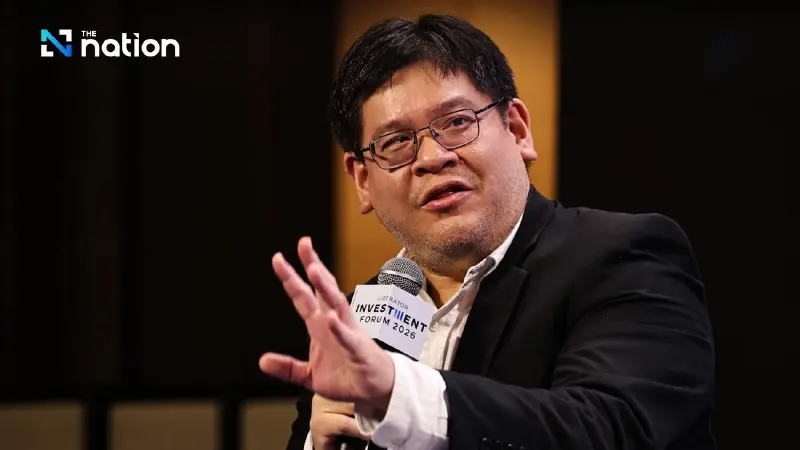


A TDRI researcher says the new world order, AI and war are disrupting investment, urging Thailand to strengthen governance and avoid becoming merely a transshipment hub.
- Global investment is being reshaped by a new world order driven by geopolitical conflicts involving Russia, China, and Iran, which are disrupting the old era of globalization.
- Artificial intelligence is intensifying geopolitical competition, particularly between the US and China, leading to monopolistic tech markets and creating unique investment risks and opportunities.
- Thailand is urged to "stand tall" by adopting a clear stance and strong governance to genuinely benefit from shifting supply chains, rather than becoming a simple "pass-through" country.
- Amid global turbulence, Thailand has an opportunity to attract investment capital, particularly from the Middle East, into its strong sectors like food and wellness.
TDRI has warned that the new world order, artificial intelligence and war are shaking global investment, saying Thailand’s economic survival depends on its ability to “stand tall” in an era of geopolitical turbulence.
Liberator Securities Co Ltd held the Liberator Investment Forum 2026: New World, New Opportunities — How to Invest for Returns today, May 23, 2026, at the Eastin Grand Hotel Phayathai.
Speaking at the forum, Nonarit Bisonyabut, senior researcher at the Thailand Development Research Institute (TDRI), addressed the topic “World Changing Opportunities: From a New World Order to New-Era Investment”.
He said the world was facing major changes and could no longer return to the old era of globalisation. Investors and policymakers now had to confront several key challenges.
Nonarit said the long-term picture clearly showed that the world would not return to the old order, where countries broadly believed in cutting tariffs to zero or continuously supporting cross-border investment. Instead, the world is entering an era in which geopolitics has become a major obstacle in three key areas.
The first is Russia, an old great power seeking to recall the historical glory of the Soviet Union, leading to its decision to invade Ukraine.
The second is China, a country with a long history that was once defeated by Western powers and Japan. Today, China is trying to restore its power and is speaking more frequently about Taiwan, one of the key territories it wants to bring back under its control.
The third is Iran, where conflict is rooted in religious principles that stand in contrast to progressive beliefs. This, he said, is a difficult problem to resolve and has spread to the threat of closing key maritime chokepoints.

Flying Geese model helps explain China’s rise
In the past, East Asia grew under the Flying Geese model, with Japan leading the way, followed by economic tigers such as Singapore and South Korea.
Thailand grew through foreign direct investment from Japan, while Vietnam expanded by linking itself to South Korea’s supply chain, especially Samsung, which accounts for around 20-25% of the country’s exports.
China, however, did not follow this model. Instead, it grew on its own. Nonarit said China should not be viewed as a single bird, but as a “flock of birds” made up of 31 provinces, each resembling a highly diverse country in its own right — from high-technology provinces such as Beijing and Shanghai to agricultural provinces such as Guangxi.
“The fact that 31 provinces compete internally but unite externally has created hyper-scale, resulting in extremely low production costs and global oversupply in areas such as solar panels and electric vehicles, which has affected investment worldwide,” he said.
AI technology and a trade war with no real alternatives
Today’s geopolitical problems have been intensified by AI, which is not merely a tool for improving production efficiency but a future technology used in competition and warfare.
This has led to monopolistic markets, as the United States refuses to use Chinese technology while China refuses to use US technology.
Although this creates risk, Nonarit said it was also “good news” for investors in certain stocks that have risen sharply because consumers have no alternative.
Thailand’s foreign direct investment figures may appear strong at nearly 1 trillion baht, but a closer look shows that investment is highly concentrated. For example, capital from TikTok alone accounts for as much as 800 billion baht.
The key question for Thailand, he said, is how the country can genuinely benefit from these supply chains.
This will be difficult because Thailand must compete with China’s 31 provinces, which are far more prepared. At present, only a small number of stocks have clearly benefited from the macroeconomic picture, such as Delta, while some parts of the recovery have been driven by external factors, including governance issues in Indonesia.
Thailand must ‘stand tall’ and seize opportunities from Middle East conflict
Nonarit said Thailand should take a clear stance by “standing tall” and using strong governance as a key tool.
He said Thailand should not allow itself to become merely a “pass-through” country or a “chip broker” through transshipment, which creates no real added value.
However, turbulence in the Middle East could also create opportunities for Thailand. Countries in the region are trying to diversify away from oil resources into other businesses, such as finance and theme parks.
If instability occurs in the region, capital could flow into Asean and Thailand, especially in industries where Thailand is strong, such as food and wellness.
“The power to change the economy and listed companies lies in the hands of investors,” Nonarit said.
“Opening opportunities for investment abroad forces Thai stocks to adapt. If Thai companies fail to build good governance and fail to change, they will not be able to retain investment, because money will always move to the best destination.”
