
Election 2026 debt pledges under scrutiny as TDRI warns of weaker financial discipline
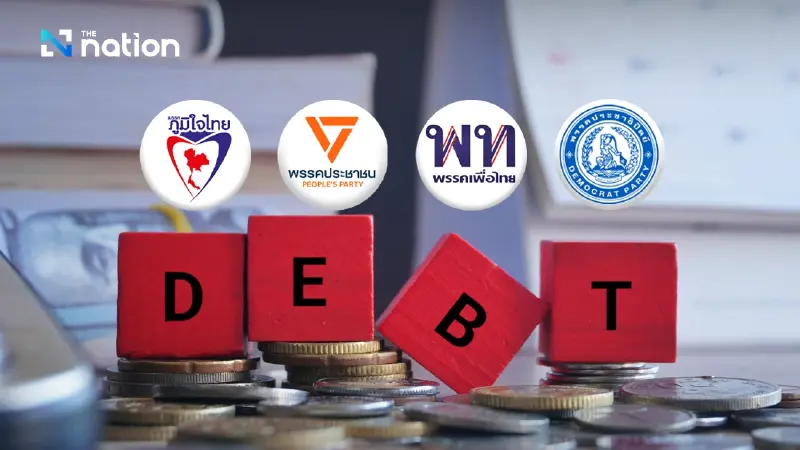


Thailand’s 2026 election has turned household debt into a key battleground, with parties pitching debt write-offs and relief schemes. TDRI warns overly generous plans may encourage non-payment and undermine financial discipline.
Household debt has become a central battleground in Thailand’s 2026 general election, with political parties rolling out high-profile “clear debt” and “fix debt” policies to attract voters amid rising household debt and weak purchasing power.
What the parties are proposing
Pheu Thai Party
Pheu Thai is promoting debt relief through budget management and quasi-fiscal measures. Its flagship proposal would clear unsecured non-performing loans (NPLs) of up to 200,000 baht, requiring debtors to pay 10% to close the debt. Funding would come from reducing transfers to the Financial Institutions Development Fund (FIDF), rather than using the central budget.
Other proposals include:
- A “retirement-age debt clearance” scheme with 4 billion baht to help older people improve quality of life and live debt-free.
- A three-year farmer debt moratorium worth around 15 billion baht.
- A “pay well, get one instalment free” incentive programme worth 30 billion baht to reward borrowers who maintain financial discipline.
- A plan to tackle informal debt, with an allocated budget of 6 billion baht.

People’s Party
The People’s Party is proposing immediate debt relief for elderly farmers—writing off debts for farmers aged 70 and over, or for those who have already repaid more than the principal—covering liabilities owed to the Bank for Agriculture and Agricultural Cooperatives (BAAC).
It is also proposing 250 billion baht in SME “start-up” loans, with the Thai Credit Guarantee Corporation increasing guarantees to 30% (from 15%) to improve access to funding for smaller businesses.
Bhumjaithai Party
Bhumjaithai is extending its earlier approach under the idea of “short-term stimulus, long-term impact”, pushing a “clear debt fast, move forward” plan featuring a three-year pause on both principal and interest payments. The party says the scheme would cover more than 1.3 million people. It also proposes establishing a new SME credit guarantee fund to encourage financial institutions to lend to small firms.
Kla Tham Party
Kla Tham is proposing farmer debt measures worth 60-90 billion baht, funded by restructuring existing debt-relief budgets and using state banks, alongside the creation of a central cooperative mechanism to address debt. The party also proposes:
- A teacher debt solution worth 15 billion baht.
- A “Banking for Thais” programme offering low-interest loans worth 7.5 billion baht per year, aimed at more sustainable debt resolution.
Democrat Party
The Democrat Party is focusing on improving access to formal credit for small borrowers by using credit scoring to assess repayment behaviour, rather than requiring collateral—aiming to expand access to regulated loans.
For farmer debt, it proposes purchasing and managing debt instead of a blanket moratorium, using 20-80 billion baht via the Farmer Rehabilitation and Development Fund, alongside a targeted three-year debt pause for vulnerable groups unable to service interest payments.
Other parties’ ideas
- United Thai Nation Party: “Credit bureau pays, clears, erases the record” — amend the law so debtors regain credit status immediately upon settling debts, and change credit-card interest calculations to apply to the remaining balance rather than the principal.
- Palang Pracharath Party: a “social security solves debt” policy with a 4 billion baht budget.
TDRI warns of “bad incentives”
Somchai Jitsuchon, research director for inclusive development at the Thailand Development Research Institute (TDRI), said many debt policies raise concerns about what economists call incentives. Effective debt solutions, he argued, should discourage excessive borrowing behaviour.
However, he warned that several proposals are “too generous” in reducing debts, which could weaken incentives to repay. Borrowers may come to believe debt is not a serious problem because the government will eventually step in to clear it—making solutions unsustainable and harming financial discipline and repayment behaviour.
“Although tackling debt is a major and urgent issue for Thailand’s economy, what we must be extremely careful about is choosing the right approach,” Somchai said.
He cited research by the Puey Ungphakorn Institute for Economic Research, which reviewed more than 13 farmer debt relief and moratorium programmes over the past 10-20 years. One striking finding, he said, was that farmers who joined multiple schemes ended up more indebted, not less.
Somchai suggested expanding measures already shown to work, such as NPL management models (AMC-style approaches) and the Bank of Thailand’s long-running “Debt Clinic” programme.
He stressed that the most important element is designing policies that change behaviour, attitudes, and improve financial literacy, rather than focusing only on debt write-offs—so debt problems can be addressed sustainably.
