
Drought-affected farmers urged to try new plants


Play
AS THE severe drought continues to ravage many parts of Thailand and rice fields wither from the water shortage, Prime Minister Prayut Chan-o-cha yesterday encouraged people to grow herbs such as mucuna pruriens instead of rice.
During a speech given to visiting young people at Government House yesterday, Prayut said mucuna pruriens could be sold at Bt800 per kilogram. He claimed that, if sent to India where it was processed into medicines and other products, the value of mucuna pruriens could reach Bt80,000 per kilogram.
“Why are we still foolishly growing something that yields small profit?” he said, adding that he had instructed the Public Health Ministry to study what herbs to promote and in which the private sector could be invited to jointly invest.
In the Northeast, farmers reportedly smuggled water out of Lamtakong Reservoir, causing a shortage of water, which was supposed to have been delivered all the way to Nakhon Ratchasima’s Muang district. Lamtakong Reservoir’s Makham Thao sluice gate in Ban Mai sub-district yesterday was drying up and visibly shallow. It has affected the sub-district’s availability of tap water for residents in the past four days. The reservoir currently released up to 430,000 cubic metres a day, but upstream farmers in Sikhiu, Sung Noen and Kham Thale Sor districts reportedly smuggled water to nourish farmlands.
Ban Mai Municipality discussed with the reservoir’s executives and Irrigation Office 8 the possibility of moving water pumps to Ban Deu check dam in Tambon Khok Kruat to push water down to the Makham Thao sluice gate. A connecting canal has been dredged to boost containment capacity to 100,000 cubic metres.
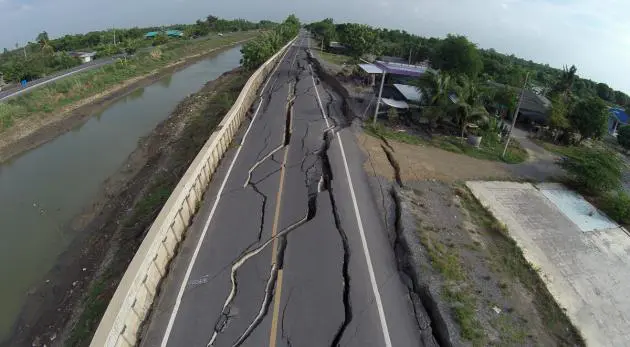
Meanwhile, Council of Engineers deputy chief Amorn Pimanmas led a team to inspect the road collapse by Klong Rapeepat in Saraburi’s Nong Khae district and a road subsidence in Ayutthaya’s Lat Bua Luang district. They said these subsidences resulted from a base failure fuelled by four factors: the soft soil condition; the sharp drop of water level during the drought season or massive water pumping out of the canal; the heavy traffic pressing weight onto the road; and the steeper canal ridges due to water erosion or canal dredging.
They suggested the Department of Rural Roads and the Royal Irrigation Department determine a slope stability and a safe ratio to be reviewed annually as figures could change so they could retain the canal level accordingly.
They also urged for good water management and warned canal-side homes of more subsidence which could worsen due to drought or flood problems.
