
Mekong meet helps states prepare for AEC


Play
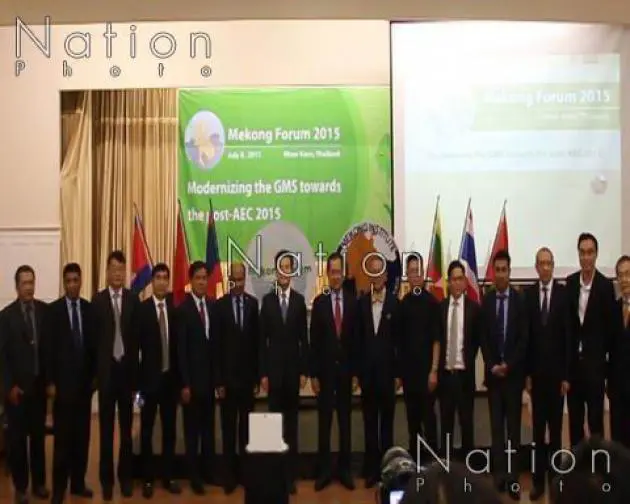
TO WELCOME the launch of the Asean Economic Community and help Greater Mekong Subregion countries cope with e-commerce, an international conference was held recently to bring specialists and officials together to swap ideas and experiences.
The July 8 event, titled “Mekong Forum 2015 – Modernising the GMS towards post-AEC 2015”, was hosted by the Mekong Institute (MI). It was organised to enable development collaboration within the GMS and Asean, while also making policy recommendations for governments to implement as they draw nearer to the start of the AEC.
Energy Minister Narongchai Akrasanee, also a member of MI’s steering panel, said the mission was to prepare for development in six countries Thailand, Laos, Cambodia, Myanmar, Vietnam and southern China linked by the Mekong River.
With member countries having seen many changes in a range of areas including the labour market, it was crucial for the Institute to embrace all facets that will come in the future, such as technology, which has played an important role in society, with tools now cheaper and more accessible, he said. So, the conference aimed to prepare people to cater to modern demands and technology, notably in the Cambodia-Laos-Myanmar-Vietnam (CLMV) group that has many young citizens and immense natural resources.
“As the AEC draws near, technology is given more and more importance. For Thailand, we have preparedness in terms of technology and our access to technology is greatly enabled by the lower pricing. When Thailand becomes an all-connected nation, it will need to strengthen energy security. Hence the AEC launch will allow Asean countries to support one another in terms of energy, so that is a win-win situation,” he said.
MI director Wacharat Lilawat said it focused on three aspects: trade and investment (such as potential development training and logistics training for small business), rural development (for (the agricultural sector, training for contract farming to ensure it is effective and just), and the flow of labour.
“GMS countries had been rather poor in the past so they had obstacles to potential development,” he said. “MI, thus helps boost manpower capabilities, especially in regard to e-commerce, which is the most effective channel for distributing goods.” He said they had experts from Alibaba.com to share knowledge with participants.
The head of Laos’ Ministry of Foreign Affairs’ Economic Affairs Department, Songkan Luangmouninthone, who is also chairman of the MI Council, said Laos had fully prepared all public, private, central and local administrations to be competent in business and human resource development when join the AEC. They also worked on law preparedness and being in line with AEC agreements, he said.
The AEC would bring investment, so they anticipated being able to export goods to Asean. It was also an opportunity for Laotians to modernise and better themselves to benefit from this move.
As the country aspires to be the “Battery of Asean”, he affirmed that the dams they build would use modern technologies and consider impacts on the environment.
