
GPO head pleads for help to adjust to new state procurement law


Play
Says its privileges provide Thais with vital access to lifesaving drugs and must stay for at least five years
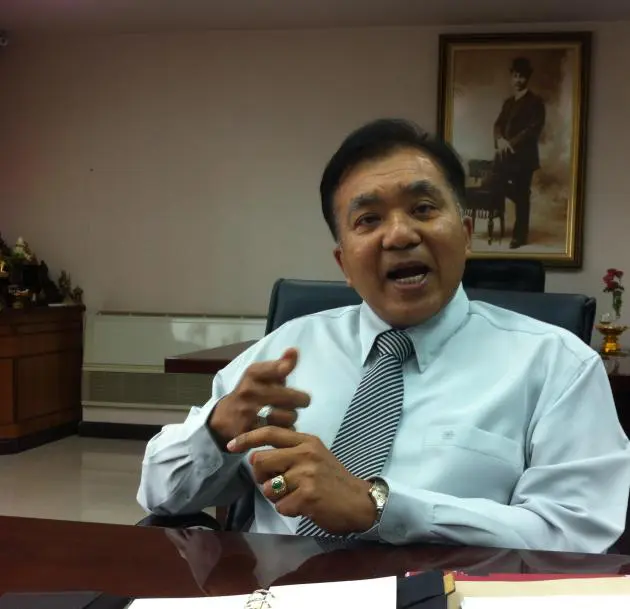
THE GOVERNMENT Pharmaceutical Organisation which sees itself as a fundamental pillar for the health sector insists that its privileges in distributing medicine and supplies to state hospitals should continue for at least five more years.
“Every year we help the country save about Bt4 billion in money that would |have otherwise be spent on imported medicines,” GPO executive managing director Dr Nopporn Cheanklin |said during an exclusive interview with The Nation. “This is just one of the reasons why we should be given time to adjust.”
For many decades, state hospitals have been required to spend at least 60 per cent of their medicine budget on GPO products. Such privileges for the GPO, however, may end as when a new law on state agencies’ procurement takes effect. The Bill on Procurement and Supply Management in the Public Sector is set to take effect in October.
Nopporn is concerned that when the new law strips GPO of its privileges, its operations may falter, affecting its mission to supply life saving drugs and low-cost medical supplies to patients.
He said GPO staff had no experience in marketing and incentive management strategies, which were the strengths of foreign drug firms, because the GPO operated with the help of its privileges.
Nopporn said the organisation would also find it hard to compete with private drug firms if the privileges were lifted, partly because it is subject to bureaucratic work processes as a state enterprise and partly because its staff are used to those privileges.
He pleaded for understanding, pointing out that the privileges had stayed with for half a century.
“We can adjust but we will need time,” he said.
Nopporn felt there was good reason for the country to grant the GPO time to adjust. At present, he said it makes many products such as anti-retroviral drugs and medicines needed for the treatment of cancer and blood-pressure problems.
He said GPO operations were linked |to the country’s health security. In an |emergency, for example, the GPO is allowed by law to produce a needed drug even if it has not been registered by the Food and Drug Administration.
Having sat at the helm of the GPO for two years, Nopporn said he saw the organisation as a crucial part of the healthcare sector not a trader.
He noted that GPO operations were gave people vital access to low-priced drugs and even unprofitable drugs.
“Private firms stop producing some types of drugs because they are not profitable. But given that some patients still need such drugs, the GPO has agreed to continue to manufacture them.”
He said just the existence of the GPO deterred private drug firms from pushing up their prices too high, as the GPO could supply generic-drug equivalents at a much lower price.
When state hospitals buy GPO products they can save a lot of money, he said. For example, a bottle of 80-per-cent alcohol solution produced by a private firm costs Bt250 while the GPO version was Bt120.
“In addition, we offer a long credit term. If they pay us within 150 days, the amount is interest free,” Nopporn said.
It was also very lenient in its repayment collection, as it understood that the refusal to send drugs and medical supplies to state hospitals might affect patients.
“We have continued to supply drugs to some hospitals even after they have left bills pending for up to four years,” he said.
And while the GPO achieved sales of over Bt12 billion a year, half of that was done via charity deals.
He said the GPO was a major supplier to the National Health Security Office and its universal healthcare scheme. This role was important given the scheme covered about 49 million Thais, offering numerous kinds of treatments for free.
The two other major healthcare systems are the social security scheme and the healthcare benefit scheme for civil servants and their family members.
Nopporn said the GPO wanted to supply drugs and medical supplies to all three schemes.
“We can supply not just medicines but also other related supplies such as artificial knee caps,” he said.
He said the GPO planned to tap the markets of Cambodia, Laos, Myanmar and Vietnam, and wants to set up an outlet that sells its skincare products, as done in China.
The GPO’s manufacturing capacity will increase once its new factory in Rangsit starts operationing.
“Its annual manufacturing capacity is about three billion tablets.”
Nopporn said he was pushing hard for construction of a vaccine facility to be built in Saraburi, a project which has been delayed for years.
“I will try to make sure that there is clear progress in this project within the next two years,” he said.
