
Prayut irritated by attacks on charter draft as vote nears


Play
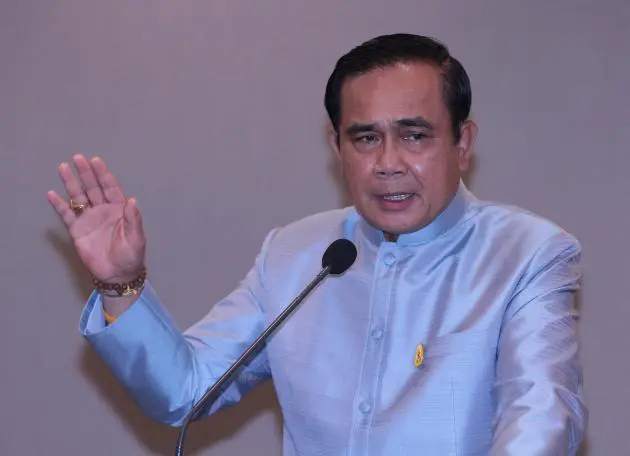
PRIME MINISTER Prayut Chan-o-cha yesterday lashed out at some politicians for encouraging the National Reform Council (NRC) to vote down the charter draft.
Democrat Party leader Abhisit Vejjajiva is the latest political figure to have openly slammed the draft, saying such a constitution would result in a "dual state" administration.The NRC is scheduled to vote on the draft on September 6.
Last week, former prime minister Yingluck Shinawatra and the Pheu Thai Party also criticised the draft charter as undemocratic. Yingluck claimed it did not link up with the people and gave more power to unelected groups than to elected politicians.
Prayut called on the media not to cover remarks made by these politicians, saying they had failed to solve the country’s problems but insulted his military-led regime, which he said was not fair.
“They should not have been allowed to make such verbal attacks. Many have court cases and have spoken out without fear. If they hit out at me, I must hit back. When they face legal action, do not scream that they do not receive justice,” he said.
“Many said they would not run in an election. That is good. Keep a note on whoever said that. Keep your word,” Prayut said.
Abhisit expressed concern over possible conflict and power tussles between the government and the planned National Strategic Reform and Reconciliation Committee (NSRRC). He said the draft charter would allow this committee to take over the country’s administration under some circumstances, thus causing a “dual state”.
Conflict may arise from implementation of so-called reforms, Abhisit said. Although the draft says an elected government would carry out reforms, it did not specify what these would be, as that would depend on what the NSRRC decided.
“If the NRC passed the charter draft and a referendum were held, opponents of the draft could move against it and violence could erupt. If the draft passed a plebiscite, there would be a political struggle to amend the charter. How could this bring the country out of the vicious circle?” he asked.
Abhisit also disagreed with posing other questions in the referendum such as on having a national-unity government consisting of a broad coalition of parties, saying it would lead to confusion and conflict. “Having a national-unity government is not a solution. The root of the problem is abuse of power by the state and weak checks,” he said.
“Please rewrite the charter. If we are going to spend an additional two to three months [working on it], that is not a problem. I do not want to run in an election and face chaos again,” he said.
Meanwhile the commander-in-chief of the Royal Thai Navy, Admiral Kraisorn Chansuvanich, said he believed that the Constitution Drafting Committee had proposed the best constitution it could and denied that the draft aimed at continuing the power of the military’s ruling National Council for Peace and Order.
Asked about criticism that the draft charter was undemocratic, Kraisorn said it depended who the criticism came from. “If people who have interests related to the draft do not like it, they may say it is undemocratic. But neutral people may find it good or acceptable,” he said. Yingluck had urged the NCPO and NRC to accept criticism and review the charter draft.
