
Jump in operations forces NHSO to review free coronary interventions


Play
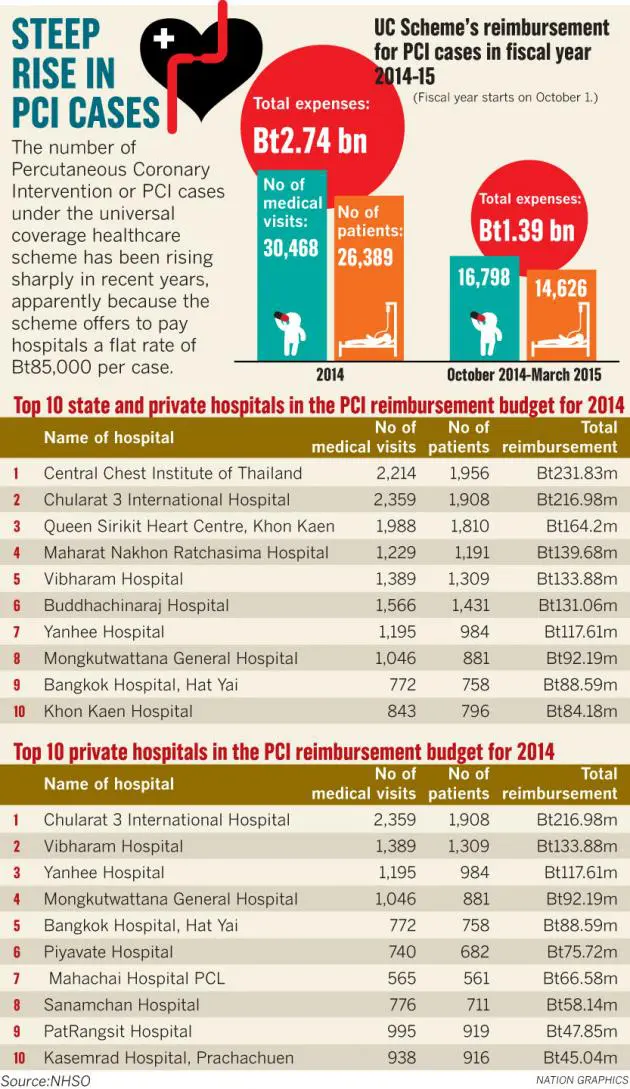
EVERY MONTH OVER the past two years, a few thousand patients have undergone percutaneous coronary interventions (PCIs) under Thailand's free-treatment scheme.
In the eyes of the National Health Security Office (NHSO) this high figure is a cause for concern because emerging information suggests some patients were advised to undergo the process when they did not really need |it.
“We believe the recommendation may have something to do with an offer by the scheme to reimburse hospitals at the rate of Bt85,000 per PCI case,” NHSO acting secretary general Prateep Dhanakijcharoen said.
The NHSO has managed the scheme, widely known as the Universal Coverage (UC) healthcare scheme.
This covers nearly 50 million Thais, offering almost all kinds of treatment for free.
Patients in the scheme used to wait a long time to get medical treatments for heart-disease such as PCIs. The NHSO, therefore, designed a new reimbursement method that allows participating hospitals to get a clear, sizeable budget for treatments in a bid to encourage private hospitals to invest in heart-care facilities. In the beginning, Bt85,000 for a PCI was not an unreasonably tempting sum, as the cost of stents and other equipment was not cheap.
But with increasingly efficient procurement in recent years, the cost of equipment has fallen. For example, each stent now costs just Bt5,000 to Bt6,000 – down from Bt10,000.
“In the past, the scheme had just a little over 1,000 PCI cases each month. Now, the number has risen to between 2,000 and 2,500,” Prateep said.
After seeing the sharp surge in cases, the NHSO got worried.
“I am concerned about the fact that some hospitals have organised activities that may spur demand for PCIs,” Prateep said.
He said he once found out that a hospital waged what was described as a corporate social responsibility campaign.
“It’s good that people have better access to healthcare and treatments. But in the face of ongoing trends, we believe it is necessary to pay close attention to quality and real needs,” Prateep said.
In response to this concern, an NHSO committee will today hold a meeting to discuss guidelines for reimbursement of PCI expenses.
“Perhaps, we will need to seek a second opinion in non-emergency cases,” Prateep said, “The second opinion, for example, may come from a panel of medical specialists.”
He said the number of private hospitals registering themselves as qualified facilities for heart-related operations has jumped significantly.
50 new ‘heart centres’
Available records show the country had just 12 heart centres in 2002. This year, the number of heart-care centres stands at 115. About 50 ‘heart centres’ have popped up over the past few years.
“In a way, it’s good that patients don’t need to face a long waiting list. But of course, we need to ensure that treatments given are not unnecessary,” Prateep said.
Speaking on condition of anonymity, a cardiologist said in general, PCI was not recommended in lesion cases with stenosis less than 50 per cent diameter.
Another source, however, disclosed that some patients were told to undergo a PCI when their symptoms had not really gone to that point. Given that PCI was free under the UC scheme and a recommendation comes from doctors, people usually agree to undergo a PCI when advised to do so.
Available records show some patients have got at least two stents in a year.
Sanatorium and Healing Arts Bureau director Dr Akom Pradittasuwan said all hospitals registering as health centres for treatments provided under the UC scheme had passed the necessary criteria.
“They have operating theatres, cardiologists, intensive care units, internists, surgeons and related equipment etc,” he said.
And his bureau had not received any complaint about the hospitals providing PCI under the UC scheme.
Asked about the sharp rise in PCI cases, Akom said, “I think the NHSO and some other relevant authorities will have to look into details there.”
