
EU decision on fishery ban in December


Play
OFFICIALS TO CHECK ON IUU WORK; 'LOT OF PROGRESS NEEDED' DEUTSCHE PRESSE-AGENTUR, THE NATION
THE EUROPEAN UNION has given itself until December to decide whether fish imports from Thailand should be banned.
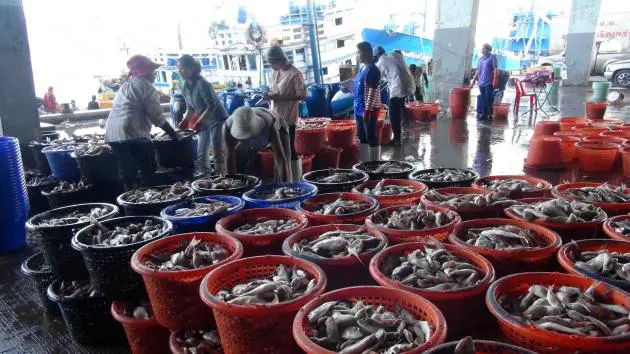
Thailand, the world’s third-largest supplier of seafood, was issued a so-called yellow card by the EU in April, throwing the country’s fishing industry into disarray and prompting fishermen to go on strike against what they said were unfair government measures to stop illegal fishing.
The EU has been cracking down on illegal, unreported and unregulated (IUU) fishing with the threat of import restrictions.
EU executives had given Thailand six months to step up the fight against illegal fishing or risk sanctions. The six months will come to an end in October.
The European Commission will then need until December to decide if Thailand’s exports should be blacklisted or if the Kingdom has cooperated enough to be granted more time to fix its problems, an EC official said on Thursday on condition of anonymity.
“Our objective is not to punish. Our objective is to have sustainable fishing worldwide,” the official said.
Relations between the EU and Thai authorities have been “excellent”, but the Kingdom still has “a lot of progress to make”, the official said.
In Bangkok, Thai Frozen Foods Association president Poj Aramwattananont said the latest EU decision was “a good sign” for Thailand.
“We have taken concrete actions in combating illegal fishing. The Thai government has worked closely with private industry. Many measures have been taken to tackle the problem and some of them need time to implement,” he said.
Poj said he expected more tangible outcomes in the remaining three months resulting from attempts to eliminate IUU fishing by the government and private sector. He expected the “yellow card” to be lifted finally and that the Thai fishery sector would not be hit hard.
He noted that during the past six months Thailand has been under pressure to act, Thai seafood exports had been affected by a shortage of raw materials rather than the EU warning.
By the middle of this month, an EU team is scheduled to come to Thailand and meet with representatives from state agencies including the Fishery Department, the Labour Ministry, and the Ministry of Social Development and Human Security.
Pornsilp Patchrintanakul, an adviser to the Board of Trade, said yesterday that he expected the EU at least to maintain its yellow card or to lift it. He said the EU had been closely monitoring Thailand and the many measures taken against illegal fishing and labour problems.
At least 15 per cent of the global fish catch is thought to be illegal, unreported or unregulated, accounting annually for up to 26 million tonnes of fish, worth up to 10 billion euros (Bt408 billion).
The EU also warned Taiwan on Thursday that it was not doing enough to tackle illegal fishing. Taiwan, which exports 13 million euros worth of fish annually to the EU, was issued a yellow card on Thursday for having “serious shortcomings” in its legal framework for fisheries, illegal-fishing sanctions that are not enough of a deterrent, and ineffective monitoring of long-distance fleets. It now has six months to address those issues.
