
Crisis management must be part of charter: Meechai


Play
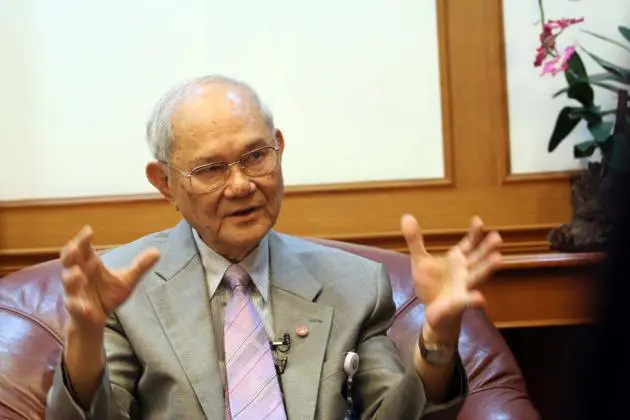
SOME sort of a crisis-management mechanism is badly needed in the new charter so that the country can cope with any political paralysis, Meechai Ruchupan, chairman of the Constitution Drafting Commission, told |The Nation in an interview yesterday.
The new constitution must include such a set-up to prevent anyone from harming the country to the point that it cannot move forward, but it’s not yet clear what form it will take and how it will work, he said.
If society has an arrangement to help enforce work on necessary agendas including reform, with a range of penalties for agencies that fail in that area, there may be no need to rely on anyone’s “intervention”. It is some “sanctions” that are being looked for.
These could be designated under the authority of some existing organisations such as the Constitution Court, which could be given more power to have a final say to end a deadlock. The entities do not necessarily include the junta, as it is not certain how long it will stay on, he said.
“What happened before is that when we had a problem we had no idea whom to turn to. But if, for instance, the [Constitution] Court could make a clear-cut stance on an issue, the issue would then be over,” Meechai said.
The CDC was appointed by the military’s ruling National Council for Peace and Order (NCPO) last Monday on October 5 to write a new charter within a six-month time frame after the previous draft was rejected by the now-defunct National Reform Council on September 6.

Among the controversies surrounding that ill-fated version was the establishment of a National Strategic Reform and Reconciliation Committee (NSRRC) to take charge in time of crisis, as it was deemed as overruling a government and was unacceptable to many.
The NCPO, headed by General Prayut Chan-o-cha, also the prime minister, wants the new charter to accommodate a five-point framework.
One of the requirements is to come up with a mechanism that promotes reform and reconciliation, triggering concerns that it would go back to the controversial NSRRC proposal. Meechai said the CDC had already agreed that for some sensitive points, it would go to the people via an opinion survey. The CDC is now |focusing on the charter’s future content.
He said he had done his best as a Thai citizen, and the CDC was not Narai (a Hindu god of creation).
“As I have gained the trust to do this job, I’m doing my best at it.
“As a carpenter, I’d like to ask the homeowner not to think alone. If you think this is your house, then you should help contribute ideas.”
The CDC was not designing – via this new round of charter writing – a “quasi-democracy” that is deemed the “Thai style”.
A Thai-style democracy is one that does not copy every word from others that fit their societies, but not Thailand’s.
Thai society needs to think seriously about its own democratic style that fits its norms, tradition and culture – something that the CDC is working on but has not yet been clear about, Meechai said.
To start with, a solid foundation is a priority and the CDC is writing this into the charter, he said. It is now seriously considering educational reform, as that can help instil basic awareness about the rights and freedom of people, which are fundamental to a democracy.
It is hoped that this will be completed before the election.
The charter, though, is not the final answer for society, he said. The framers will define some key principles and leave the rest to be fleshed out in the future.
What is certain is that it should not be easily amended, especially by certain political parties, as this is dangerous to society as a whole as well as to other parties, he claimed.
The factors that may collapse the process are mixed, ranging from the new content to the political atmosphere.
All stakeholders should discuss with the CDC which elements they see as undemocratic, including the framework given by the NCPO as well as that under Article 35 of the provisional charter, he said.
