
Pheu Thai accuses govt of targeting Yingluck over rice scheme


Play
THE PHEU Thai Party has defended former prime minister Yingluck Shinawatra over allegations related to the party's flagship rice-pledging scheme that caused up to Bt500 billion in damages to the state.
The party yesterday issued a statement stating the government’s move to make Yingluck pay over civil liability incurred from the scheme has sparked criticism about a lack of transparency and justice in the legal procedures against her.
Pheu Thai claimed that the Abhisit government had caused losses to the state from its rice subsidy scheme and the Prayut government had caused Bt4 billion in losses from rubber deals with the Chinese government but no action was taken.
However, Deputy Prime Minister Wissanu Krea-ngam said the government would face charges of dereliction of duty if it failed to take action against Yingluck and the statue of limitations in the case expired.
He said the administration must take action because the National Anti-Corruption Commission had forwarded this case to it and not other cases.
“This is an issue because the NACC had warned the Yingluck government about corruption in the scheme but it ignored the warning,’’ Wissanu said.
Pheu Thai said in the statement that the rice-pledging scheme was aimed at supporting farmers like other state welfare projects such as basic infrastructure projects, welfare funds for the less privileged, the disabled and the elderly, and universal healthcare.
It also highlighted the rice subsidy scheme, the rubber subsidy scheme and handing out of Bt1,000 per rai to farmers.
“There is no country in the world that takes into account profits or losses from these [sorts of] policies,’’ it said.
The party said the Pheu Thai-led government had spent around Bt870 billion on supporting farmers.
It said the money had circulated throughout the country and greatly contributed to economic growth, while the government had collected additional taxes of up to Bt100 billion per year.
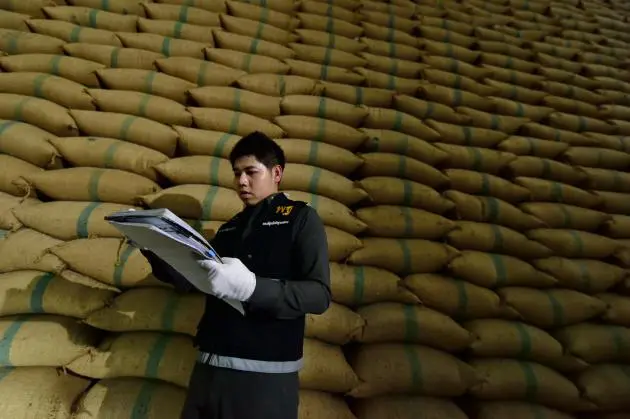
Pheu Thai, however, failed to mention the high cost of maintaining rice stockpiles including warehouse rents and the fact that rice was kept for too long and had gone rotten or become infested with weevils or degraded beyond the point of being suitable for human consumption.
Pheu Thai also failed to dismiss widespread reports about rice-miller corruption and embezzlement as state inspections found rice stocks in their warehouses that did not match the amounts reported to the government.
Not only were hundreds of tonnes of rice missing from inspected warehouses, much of what was there had spoiled. Inspection officials found scaffolding instead of rice sacks in the middle of warehouses in some provinces.
Pheu Thai claimed that exporting the rice under the rice-pledging scheme enabled the country to earn more income from rice exports and secure the status as one of the world’s top rice exporters.
But the party failed to dismiss reports that Thailand had lost its crown as the world’s top rice exporter because of the Yingluck government’s failed rice-pledging scheme, which attempted to manipulate the international rice market by withholding stocks to drive up prices. Competing nations took steps to boost supply at lower prices.
Pheu Thai said the corruption accusation against Yingluck, who oversaw the policy, was not fair and was untrue.
The Thailand Development Research Institute however estimated total corruption of Bt111 billion in the scheme and reported that corruption existed at all of the programme’s levels – from upstream corruption (farmer registrations, rice sales and millers) and midstream corruption (millers, surveyors, warehouse owners and government officers).
Pheu Thai quoted the NACC investigative report in the matter as saying “there was no evidence that Yingluck took part in the corruption or allowed corruption by others”.
The party said the corruption accusation against Yingluck was politically motivated by her opponents to destroy her.
“The most unjustified way is to rush the legal process to make Yingluck pay hundreds of billions of baht in expenses over the rice-pledging scheme even though evaluation of ‘the damages’ are still debatable and the Supreme Court’s Criminal Division for Office Holders has just started the criminal trial against Yingluck,’’ Pheu Thai said.
