
Red shirts go to ground after Article 44 used


Play
No rallies or activities reported yesterday, govt says, despite plan to give moral support to Yingluck
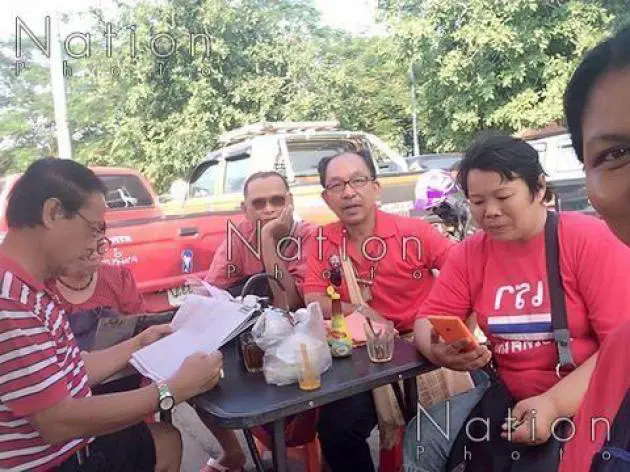
RED SHIRTS in major provinces were quiet yesterday, failing to give a moral boost to former prime minister Yingluck Shinawatra as she faces increased pressure from the junta over her government’s rice-pledging scheme.
Prime Minister General Prayut Chan-o-cha on Saturday resorted to using Article 44 of the interim charter to provide blanket protection to officials involved in the investigation into the scheme against counter-attacks by Yingluck supporters. The announcement appeared to help silence pro-Yingluck movements, despite days of invitations on social media for supporters to wear red yesterday.
No political activities were launched by the red shirts, or supporters of the Pheu Thai Party, in provinces believed to be their strongholds – chiefly Chiang Mai, Khon Kaen, Udon Thani and Nakhon Ratchasima.
In Muang Nakhon Ratchasima, key leaders were seen in red shirts at a local coffee shop early in the morning before dispersing.
Jakkrawut Traiwallop, one leader, said gathering at the coffee shop was routine. “Don’t implicate us in any political activity. Now, the Muang district is a lightening bolt, a symbol of stability in Isaan. Every time any conflict issue emerges, red leaders will be closely watched. Red is the Sunday colour. Wearing it today contains no connotation.”
Chiang Mai red-shirt leader Pichit Tamool said no activities were planned yesterday as that would go against the National Centre for Peace and Order’s order. “No red shirt people here want to violate the law. We may have meals, but that will involve no more than three to five people at a time,” Pichit said.

Former Pheu Thai MP Julapun Amornwiwat and former deputy government spokesman Anusorn Iamsaard posted pictures of themselves in red clothes yesterday.
But Panthongtae Shinawatra, Thaksin’s son, appeared on Instagram in a white polo shirt with the message: “This shirt is red” and the hashtag: “offering moral support without wearing red (today), Auntie Poo#99 per cent obedient”. His ‘Auntie Poo’ is Yingluck.
Yingluck herself wore a grey and deep-purple outfit yesterday. Red-shirt leaders Jatuporn Promphan and Natthawut Saikua did not post anything on Facebook yesterday.
Government spokesperson Maj-General Sansern Kaewkamnerd said: “Everyone has the right to prove themselves by showing their evidence. But they should not change topics by claiming that [Yingluck] was elected, a high-ranking political officer or a woman. That does not mean you will be innocent.”
The government was determined to ensure people can distinguish facts from distorted information, the spokesman said.
Wearing red in an Instagram post, former prime minister Thaksin Shinawatra, the elder brother of Yingluck, did not mention the rice-pledging scheme. He just said justice would win the hearts of the red shirts.
The strongest message against the invocation of Article 44 came from Boonsong Teriyapirom, the former commerce minister who is standing trial for allegedly selling government rice to “ghost” Chinese companies while in office.
In a Facebook post, Boonsong said he was saddened to see Yingluck have to defend herself in court.
He said using Article 44 to protect officials and organisations involved in the rice-pledging scheme was proof that Yingluck Shinawatra was a political victim and the scheme had also been targeted for political gain.
He said Yingluck had no direct responsibility to the scheme. Though it was a government policy, it was carried out by a sub-committee.
He insisted the Guangdong Stationary & Sporting Goods Import & Export Corp and Hainan Grain and Oil Industrial Trading Co, which purchased rice under government-government deals, were considered part of the Chinese government as they were 100 per cent owned by the government.
They enjoy the same status as Guangxi Mingyang Biochemical Science & Technology which bought tapioca flour under a G2G deal with the Abhisit government in 2000 and China Hainan Rubber Industry Group Co, which struck a similar deal for Thai rubber during the Prayut administration.
He insisted all the companies were screened by Foreign Trade Department.
The tapioca flour and rubber deals “were conducted in the same way as the rice deals struck during the Yingluck administration. The only difference is the deals did not face collusion charges from the NACC [the National Anti-Corruption Commission]”, Boonsong said.
He said warehouse operators were legally responsible for missing stockpiles or degradation. Demanding Yingluck or others take the responsibility was politically motivated.
“The use of Article 44 to protect all |individuals and organisations tasked to |handle this matter is proof that the rice-pledging scheme is being used as a political tool to ruin Yingluck and the Pheu Thai Party.”
