
'An act of war by IS'


Play
Islamic state claims responsibility, warning France will not live peacefully if it took part in coalition raids in Syria
French President Francois Hollande said yesterday the deadly attacks in Paris that killed at least 127 people were “an act of war” organised from abroad by Islamic State with internal help.
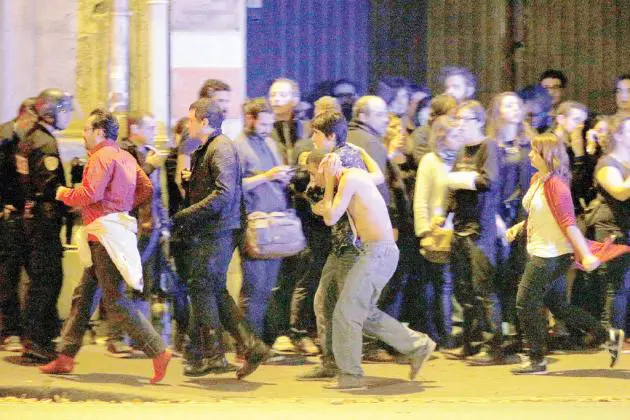
France will hold three days of national mourning in the wake of terrorist attacks in Paris. Gunmen and bombers attacked restaurants, a concert hall and a sports stadium at locations across Paris late on Friday in a deadly rampage.
“It was an act of war that was prepared, organised or planned from outside and with domestic involvement that the investigation will allow to establish,” he says. “All the measures to protect our fellow citizens and our territory have been taken.”
“Because it was attacked in a cowardly way, in a shameful way, in a violent way, France will be ruthless against the barbarians of Daesh [IS],” Hollande said, urging the French to be united and to keep a cool head, saying their country “always gets back up, even if it is injured”.
There was no immediate claim of responsibility, but Islamic State released an undated video in which a militant said France would not live peacefully as long it took part in US-led bombing raids against its fighters.
A Paris city hall official said four gunmen systematically slaughtered at least 87 young people at a rock concert at the Bataclan concert hall. Anti-terrorist commandos launched an assault on the building. The gunmen detonated explosive belts and dozens of shocked survivors were rescued, while bodies were still being removed yesterday morning.
Some 40 more people were killed in five other attacks in the Paris region, the official said, including an apparent double-suicide bombing outside the Stade de France national stadium, where Hollande and the German foreign minister were watching a friendly soccer international. Some 200 people were injured.
The coordinated assault came as France, a founder member of the US-led coalition waging air strikes against Islamic State in Syria and Iraq, was on high alert for terrorist attacks ahead of a global climate conference due to open later this month.
It was the worst such attack in Europe since the Madrid train bombings of 2004, in which 191 died.
Hollande said the death toll stood at 127. Officials said eight assailants had died, seven of whom had blown themselves up with explosive belts at various locations, while one had been shot dead by police. It was not clear if all the attackers were accounted for.
“The terrorists, the murderers raked several cafe terraces with machine-gun fire before entering [the concert hall]. There were many victims in terrible, atrocious conditions in several places,” police prefect Michel Cadot told reporters.
After being whisked from the stadium near the blasts, Hollande declared a national state of emergency – the first since World War Two. Border controls were temporarily reimposed to stop perpetrators escaping.
“This is a horror,” the visibly shaken president said in amidnight television address to the nation before chairing anemergency cabinet meeting.
He later went to the scene of the bloodiest attack, theBataclan music hall, and vowed that the government would wage a “merciless” fight against terrorism.
Emergency services were mobilised, police leave was cancelled, 1,500 army reinforcements were drafted into the Paris region and hospitals recalled staff to cope with the casualties.
The deadliest attack was on the Bataclan, a popular concert venue where the Californian rock group Eagles of Death Metal was performing. The hall is near the former offices of the satirical weekly Charlie Hebdo, target of a deadly attack by Islamist gunmen in January.
Some witnesses in the hall said they heard the gunmen shout Islamic chants and slogans condemning France's role in Syria.
Hollande cancelled plans to travel to Turkey at the weekend for a G20 summit.
US President Barack Obama and German Chancellor Angela Merkel led a global chorus of solidarity with France. UN Secretary-General Ban Ki-moon condemned the “despicable attacks” while the Vatican called the killings “mad terrorist violence”.
Julien Pearce, a journalist from Europe 1 radio, was inside the concert hall when the shooting began. In an eyewitness report posted on the station’s website, Pearce said several very young individuals, who were not wearing masks, entered the hall during the concert, armed with Kalashnikov assault rifles and started “blindly shooting at the crowd”.
“There were bodies everywhere,” he said.
Toon, a 22-year-old messenger who lives near the Bataclan, was going into the concert hall with two friends at around 10.30pm (2130 GMT) when he saw three young men dressed in black and armed with machine guns. He stayed outside.
One of the gunmen began firing into the crowd. “People were falling like dominoes,” he told Reuters. He saw people shot in the leg, shoulder and back, with several lying on the floor, apparently dead.
Two explosions were heard near the Stade de France in the northern suburb of Saint-Denis, where the France-Germany soccer match was being played. A witness said one of the detonations blew people into the air outside a McDonald’s restaurant opposite the stadium.
The match continued until the end, but panic broke out in the crowd as rumours of the attack spread, and spectators who were held in the stadium assembled on the pitch.
Police helicopters circled the stadium as Hollande was rushed back to the interior ministry to deal with the situation.
In central Paris, shooting erupted in mid-evening outside a Cambodian restaurant in the capital’s 10th district. Eighteen people were killed when a gunman opened fire on Friday night at diners sitting on outdoor terraces in the popular Charonne area nearby the 11th district.
The prosecutor mentioned five locations in close proximity where shootings took place around the same time.
