
Relatives of 2010 victims slam NACC resolution


Play
RELATIVES OF victims of the 2010 Ratchaprasong crackdown yesterday issued a statement protesting the National Anti-Corruption Commission (NACC)’s resolution not to press charges against former prime minister Abhisit Vejjajiva and others in connection with
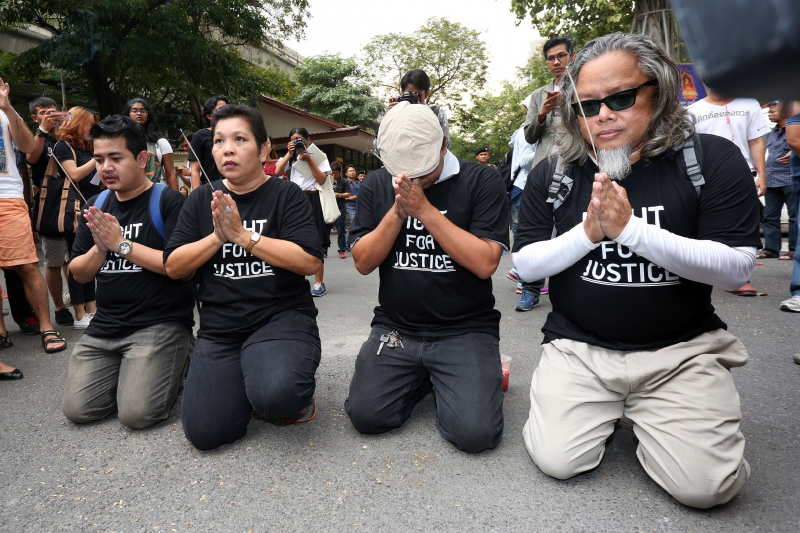
As a symbolic move, they marched from Wat Pathum Wanaram, where some protesters were killed by unknown gunmen at night, to the October 14 Memorial.
The NACC last week resolved to drop its accusations against Abhisit, then-deputy PM Suthep Thaugsuban, and ex-Army chief General Anupong Paochinda, who were all accused of malfeasance for ordering police and military officers to disperse the protesters, resulting in deaths and injuries.
The NACC said the accused, who were in charge of the Centre for the Resolution of the Emergency Situation (CRES), had reviewed and adjusted their directives after the bloody clashes on April 10, resulting in ceasing the use of force and setting up checkpoints instead.
The relatives challenged the NACC statement and argued that the CRES’ review and adjustment of plans and directives had instead resulted in more stringent measures against the protesters.
They claimed that more snipers were deployed, shooting was allowed in several areas, real bullets and heavy weapons as well as night crackdowns were authorised, and medical services for the injured were suspended.
They faulted the argument that the accused had followed international standard guidelines. They said no advance announcements were made about the dispersal plan, while tear gas and batons were used indiscriminately.
The relatives said the government’s directives against innocent protesters had the clear intention to harm them because a state of emergency was declared to pave the way for the use of force. Besides, real bullets were used, crackdown operations night crackdown operations, fault accusations against the protestors, plus repeated rejections for negotiations.
The relatives said the NACC fact-finding procedures lacked transparency and accountability, as it did not call on victims to testify before coming up with the resolution.
They condemned the NACC resolution as erroneous and lacking in justice, while promising to fight for the truth and bring the real culprits to justice.
Deputy Prime Minister Prawit Wongsuwan said he did not wish to see the relatives staging protests at the moment, as the government has been trying to solve past problems and move the country forward. The government would try to explain the situation to them to create understanding, he added.
The relatives led by Phayaw Akkahad, mother of Kamolkaed Akkahad, a nurse who was killed at the temple, read a statement after reaching the memorial.
“I have been idle for long, but I’m forced to fight again,” Phayaw said.
“The case will be returned to the Department of Special Investigation [DSI]. As many of its officers were appointed by the junta government, I don’t trust them,” she added.
The mother also looked forward that cases involved with losses of lives during the uprising would truly enter justice process instead of being hindered by the NACC, of which she called “only another independent agency”.
The NACC never called her or the relatives of other victims to provide testimony relating to the case, she said.
The mother, however, admitted that the way ahead could be dim. “Authorities involved in the uprising are ruling now, so the path ahead won’t be easy for me.”
Pansak Srithep, whose son Samapan Srithep was also killed during the clashes, read a statement condemning the NACC resolution.
Pansak will join other plaintiffs in suing authorities who were in charge at the time in civil courts.
Phayaw, Pansak and siblings of other victims paid their respects to Kamolkaed at Wat Pathum Wanaram at the site where she was shot.
The group then walked to the memorial to read statements and lit candles in memory of the victims.
They were joined at the memorial by relatives of other victims, including Wasu Suriuakaenkai who was paralysed as a result of the attack during the uprising.
Altogether, they lighted black candles in condolence to the lost victims while singing a song entitled “Dust fighters”, implying to the victims' fighting spirits till death.
More than 10 police officers were posted yesterday at both Wat Pathum Wanaram and the October 14 Memorial.
