
Experts doubt quake will impact volcanoes in Japan's Kyushu region
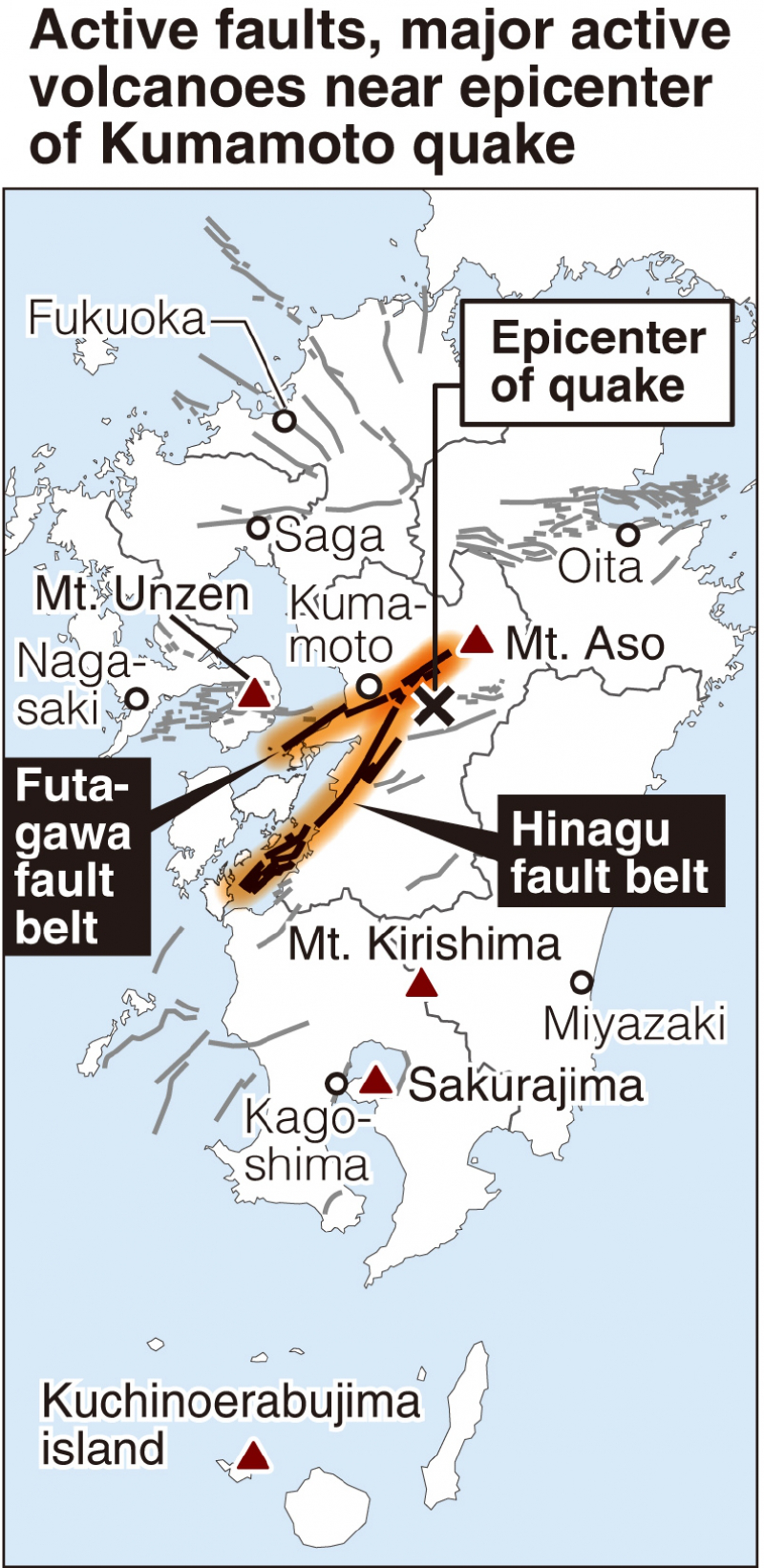


The Kyushu region is home to many active volcanoes, but experts believe Thursday’s powerful earthquake in Kumamoto Prefecture is unlikely to trigger significant volcanic activity in the region.
Active volcanoes in the region include Mt. Aso in Kumamoto Prefecture, Sakurajima in Kagoshima Prefecture and Mt. Unzen in Nagasaki Prefecture.
After the Great East Japan Earthquake in 2011, heightened activity was detected at volcanoes including Mt. Hakone, which sits on the border of Kanagawa and Shizuoka prefectures. However, experts doubt Thursday’s earthquake will trigger such a phenomenon, as it was not a large-scale earthquake that had an impact over a wide area, and therefore is unlikely to have any connection to these volcanoes.
The closest volcano to the quake’s origin is Mt. Aso, which is about 35 kilometers away. The volcanic alert level for Mt. Aso is 2, meaning people should not approach the crater.
“An active fault moved at quite a shallow depth,” said Toshitsugu Fujii, chairman of the Japan Meteorological Agency’s Coordinating Committee for Prediction of Volcanic Eruptions and a professor emeritus at University of Tokyo. “Magma didn’t set off this earthquake. Therefore, there is very little possibility of it having any effect on the magma under Mt. Aso.”
This view was echoed by Kazuhiro Ishihara, deputy chair of the committee.
“Mt. Aso has always been active, so even if there’s a temporary increase in slight tremors, a major eruption won’t happen anytime soon,” said Ishihara, a professor emeritus at Kyoto University. “There’s no need to worry, provided people remain outside the restricted area.”
Ryusuke Imura, an associate professor at Kagoshima University and an expert in volcanic geology, also doubted there would be any connection between the earthquake and volcanic activity. “But the volcano needs to be continually monitored, just in case,” Imura said.
