
Thailand commemorates student massacre four decades later


Play
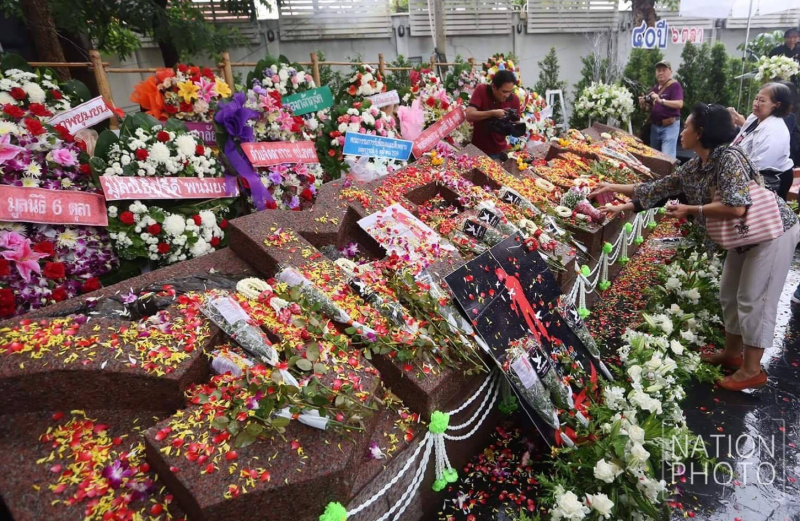
Bangkok- Hundreds of people gathered Thursday at Thammasat University in Bangkok, the scene of a bloody massacre four decades ago that killed more than 40 students and wounded more than 100.
Survivors and victims' family members, as well as current students and professors, laid wreaths at the university memorial.
At dawn on October 6, 1976, police, military and paramilitary forces blocked campus exits and opened fire on students. Victims were reportedly raped, hanged, beaten and burned to death. The annual commemorations saw waning participation in recent years. But this year saw student activist sentiment reignited, with the country's top three universities co-hosting commemorative activities for the first time.
Central to the commemorations is a photo exhibition featuring black and white images of the crackdown. One shows a beaten man hanging from a tree. The perpetrators included a right-wing order connected to the military that feared the communist expansion promoted by left-wing students, explained Thitinan Pongsudhirak, a political science professor at Chulalongkorn University.
With Prime Minister Prayut Chan-o-cha's promise of elections and the end of military rule in 2017, some see lessons from the 1976 massacre.Thailand has been under a military rule since a coup d'etat was staged in May 2014.
"Four decades later, the established order that put down the earlier challenge now confronts self-empowering communication tools and international norms such as democracy and elections," Thitinan said.
Those in power need to change and adjust to accommodate new voices, Thitinan said.
"If not, the country will see more tension that can only (lead) to more turmoil," he added.
-DPA
