
Clinton has the edge following a toxic campaign


The current US presidential election campaign has attracted global attention for three main reasons. First, US is the sole global superpower and what the president of the US does can have repercussions elsewhere.
Second, the two main contenders Democrat Hillary Clinton (69), and Republican Donald Trump (70) are somewhat unusual candidates. Mrs. Clinton, if elected, would be the first ever female president of USA. Trump is a rich businessman who has never held elected public office.
Third, the campaign itself is unusual. About 55% of the voters view both candidates unfavorably. Clinton is seen as untrustworthy. Trump calls her "Crooked" Hilary and suggests that she belongs not in the White House but in jail for her alleged "criminal" mishandling of emails while she was Secretary of State. Very many, especially women, view Trump as a misogynist. He has refused to release his tax returns as presidential candidates normally do and has shown to be less than truthful and honest in some of his business deals. It is reasonable to say that America could have done better in nomination for the presidency. But these are the two candidates that, democracy, American style, has produced.
Electoral College
Approximately 225 to 230 million will be eligible to vote in this election. The actual number registered to vote would be less. What is more important for the outcome next Tuesday is not the total but the composition of the electorate. It is the most diverse ever with about 69% white and the balance 31% belonging to ethnic minorities; 12% African Americans, 12% Hispanic/Latino, and 4% Asian.

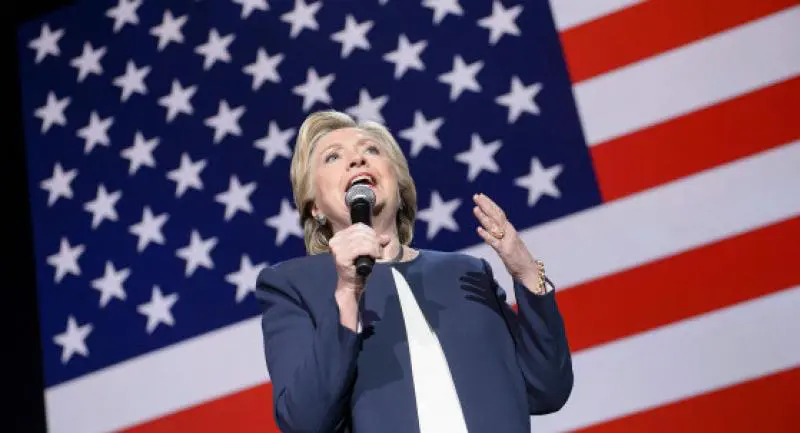
People listen as Democratic presidential nominee Hillary Clinton speaks during a rally at Eastern Market November 4, 2016 in Detroit, Michigan. / AFP PHOTO
The US presidential election is different to most other such elections in one respect. It is not decided directly by the popular vote with the winner being the candidate securing the largest number of votes. Instead US has an "Electoral College" that has a total of 538 Electoral College votes. The distribution of the 538 among the 50 states roughly matches the population of each state. With the exception of two small states, the winner in each state gets the entire Electoral College vote of that state. The winner of the presidency must get a minimum of 270 electoral votes. Usually the winner of the popular vote also wins the Electoral College vote. But there are exceptions. In 2000 Democrat Al Gore won the popular vote nationwide by about 500,000 votes. But he lost the Electoral College vote 266 to 271 to George W. Bush.
Issues
Mrs. Clinton’s campaign theme "Stronger Together" stresses unity across races, religions, rich and poor, and gender orientation. She promises to continue and further strengthen Obama’s policies such as health care insurance that provided coverage for 20 million of the 49 million uninsured. She is also committed NATO, fighting ISIS, and working towards mitigating global climate change.
Trump’s campaign theme is "Let’s Make America Great Again." In his campaign speeches Trump accuses Obama and Clinton of making America weak militarily and economically. Opinion polls indicate that this theme appeals in particular to older whites, especially men without a college degree. Trump gets open support from the far right including the racist Ku Klux Clan. The Trump campaign theme also invokes memories, especially among a segment of the white electorate, when the whites dominated every aspect of the nation’s life from the economy to politics in a much less diverse nation. There is no realistic way to reverse history. America today is what it is and Trump’s rhetoric has little substance. However, many of his followers have a genuine grievance arising from rapid global change that the next president must address.
Globalization
US has been the principal advocate of free markets, free trade and globalization. It has been the dominant power in the Post World War II global economic institutional structure that includes, most notably, the IMF, World Bank, and WTO. The collapse of the Soviet Union and the replacement of "socialism" with capitalism in Russia, China and elsewhere made US the winner of the cold war. This victory has benefitted USA a great deal. The US economy has recovered well from the 2008 financial crisis and today outperforms other major western economies.

Democratic presidential nominee former Secretary of State Hillary Clinton takes a selfie with supporters during a campaign rally at Eastern Market on November 4, 2016 in Detroit, Michigan. With less than a week to go until election day, Hillary Clinton is campaigning in Pennsylvania, Ohio and Michigan. /AFP
However, there is also a downside to this story. Thanks to free trade and free movement of capital, China and other newly emerging countries have captured sizable portions of the US market. US companies have closed down factories in the country and moved to Mexico and elsewhere that offer cheaper labor. A sizable share of Trump supporters, mostly white blue-collar middle class, are the victims of this major economic upheaval. Many have lost their jobs and seen their incomes stagnate. The irony is that it is the Republicans who have strongly supported free markets and free trade. Trump who is the candidate of that party has almost unilaterally declared that if he wins free trade agreements such as the North American Free Trade Agreement (NAFTA) with Mexico and Canada would be abandoned or drastically changed, and import tariffs would be imposed to bring back industries that have left the country. He also proposes to build a wall in the southern border to keep out Latin American immigrants who come illegally.
Trump’s rhetoric against free trade has reached such a pitch that Mrs. Clinton, who was a strong supporter of the twelve-nation Trans Pacific Partnership (TPP) that Obama negotiated over five years, has now declared her opposition to it. Foreign Minister Mangala Samaraweera addressing a gathering in Washington, D.C. last February stated that Sri Lanka would actively pursue seeking membership or some other form of association with TPP. Let alone Sri Lanka seeking membership, it is very unlikely that TPP would come into existence at all, no matter who the next occupant of the Oval Office is.
Results on November 8th
There are a large number of election polls that come out daily. Some of these are reliable and others not. At the national level, to date the only time that Trump led Clinton in the more reliable polls was in late July soon after the Republican national convention that gave Trump a boost in the polls. More importantly, Trump’s average in the national polls has been in the lower forties and have never touched 46%. In contrast Clinton’s poll share has been fluctuating in the mid to upper forties. At the time of this writing, November 03, Clinton leads Trump 47.0% to 45.3%. Given the fact that this is well within the margin of error, it appears to suggest that Trump has an upper barrier of around 45% and that is not good enough to win the election. However, an eleventh hour "wave" (Ralla in Sri Lankan parlance) in favour of Trump cannot be fully ruled out.
Going by US presidential elections in the past few decades, if a candidate leads by 5% points or more in the national poll on the eve of the election, it is safe to predict that he or she would win. But Clinton’s current margin is much narrower. In 2012, on the Thursday before the Tuesday poll, Obama and Mitt Romney were even and the former went on to win the election 51.1% against the 47.2% for the latter. That should give some comfort to Clinton. However, it is too risky to project on the basis of the last election partly because since Friday October 28, there is some movement, though not substantial, in favour of Trump.
Gender and Ethnic Gaps
There are other indicators that generally favour Clinton. In the presidential election of 2008 as well as 2012 women accounted for 53% of the total votes cast. Polls suggest that men favour Trump by about 5% points and women favour Clinton by about 10% to 15% percentage points. That creates a gender gap of 5 to 10 points. If that holds Clinton will win.

Democratic presidential nominee Hillary Clinton greets supporters during a rally at Eastern Market November 4, 2016 in Detroit, Michigan. / AFP PHOTO
While over 90% of African Americans will vote for Clinton, there is evidence to suggest that the total number of African American voters turning out will be less than for Obama. This will be a problem for Clinton. Obama has been campaigning for Clinton in the last few days mainly with the intention of persuading African Americans and Millennials (younger voters) who strongly supported him in 2008/12 to vote for Clinton. The Hispanic (Latino) turnout is expected to be quite high. Polls indicate that Clinton will get about 70% of that vote and Trump only about 20%. In 2012 the Republican candidate Romney polled 27% and Obama got 71%.
Battle Ground States
An assessment based on each state is a more reliable guide to the likely outcome. The website Real Clear Politics (www.realclearpolitics.com) in its latest (November 03) assessment gives Clinton 226 electoral college votes for certain and Trump 180 leaving 132 (11 states) as toss ups. It then allocates the toss-ups based on the latest available polls and gives Clinton 273 and Trump 265. However, this assumes that Florida that has 29 Electoral College votes goes to Trump. The most recent poll (November 01/02) shows Clinton leading by 4% points in Florida. If that holds Trump has almost no way to reach 270.
Overall, Americans have to decide next Tuesday whether they want as their president, a woman who mishandled her email but has the qualifications and experience to hold that position or a man who is good at sloganeering but shows little awareness and understanding of the complexities and responsibilities that the office bestows on one who becomes president.
Challenges for the New President
The next president, most likely Hilary Clinton, will have to face some massive problems and challenges. After the Republicans got control of the House in 2010, Obama found it very hard to pass legislation that he favoured. It became even more difficult for Obama after the Republicans captured the Senate as well in 2014. As of today the House is likely to remain Republican but there is slightly better than even chance that Democrats may capture the Senate. Even with a friendly Senate a President Clinton will find a highly polarized and toxic atmosphere in Washington. Many Trump supporters believe that she should be in prison rather than in the White House. Some Republican lawmakers have already signaled that they would initiate impeachment proceedings against her if she wins and some others have stated that they would deny her the right of the president to nominate a Supreme Court justice.
Partisan animosity apart, USA will have to initiate a massive structural adjustment program of its own – the favorite prescription that IMF orders for developing countries such as Sri Lanka – to remedy the economic problems that globalization has created in the country. US has ample resources to do it. For example, Mrs. Clinton has promised a massive infrastructure development program that could be a part of the solution. But overcoming poltical gridlock won't be easy when many who oppose Mrs. Clinton are not willing to accept her legitimacy.
