
Only summary of politicians’ assets ‘will hurt anti-graft fight’
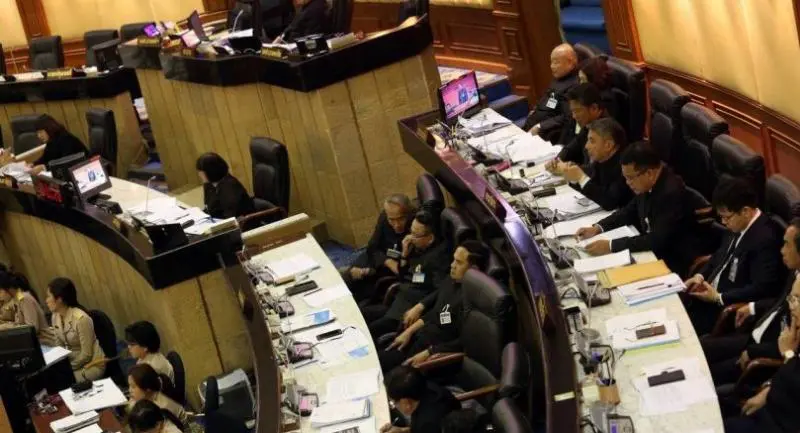


GRAFT BUSTERS fear the provision in the new National Anti-Corruption Commission (NACC) organic bill that the agency only publicly publish a “summary”, not a detailed report of the assets declared by political office holders and commissioners of independent bodies, could weaken transparency and cripple public scrutiny of corruption.
The bill has already passed the first reading by the National Legislative Assembly (NLA) earlier this month and is currently being revised by an ad hoc committee before returning to the table again for the second and third readings.
Mana Nimitmongkol, director of the Anti-Corruption Organisation of Thailand (ACT), said the new provision would unnecessarily undermine scrutiny of corruption by the media and the general people.
In the past, the media and the people could help scrutinise politicians, as they were allowed to see the complete reports, he said. More than half of the scrutiny had been initiated by the public, and the government agencies took them from there, he added.
“Remember, the people have more eyes and ears than a handful of busy government officials,” Mana pointed out.
Jade Donavanik, an adviser to the Constitution Drafting Commission (CDC) responsible for the initial draft, said the new provision was the result of the drafters’ opinion that it could help lighten the workload of the NACC.
Jade explained that in reality, the general people as well as the media did not really use the detailed report. He pointed out that of the 500 asset items, people usually were interested in and highlighted only 10 or 20.
Although the NACC would only produce and publish a summary of the assets, Jade said people and the media could still have access to the detailed assets list. This, however, might require a little paperwork, he said.
Mana did not agree with the argument that publishing the detailed assets list would impose a huge burden on the NACC.
“Everything is provided by the politicians,” he said. All that the NACC has to do is disclose the papers to the people, Mana added.
Review of suggestion likely
Despite the contention that people could still have access to the report, Mana was concerned that there might be some conditions. For instance, they would perhaps allow only stakeholders or people affected by the matter, he added.
Jade, who is a member of the ad hoc committee revising the NACC bill, said this provision was not found to be controversial at all in the meeting. However, since it had received the media attention maybe when the committee discusses the stipulation again in detail, they could reconsider it, he added.
Another CDC member, Chartchai na Chiangmai, provided another reason for the controversial provision, saying there must be a balance between transparency and privacy.
Chartchai rejected the notion that this would compromise the transparency secured in the old law, which requires political holders taking or leaving office to report their assets, which would be later released in detail to the public.
The drafter said the NACC is given the authority by the new charter to handle the issue, including determining who must report their assets. By law, the NACC would be required to scrutinise the assets in detail and safeguard the information in case irregularities occur.
Since the 1997 Constitution, Cabinet members have been required to declare their assets when entering and leaving office to the NACC to reveal them to the public. Several politicians had been scrutinised because of this law such as the late Maj-General Sanan Kachornprasart who was later ousted from his interior minister post and banned from politics for five years for making a false declaration of assets.
*************************************
MATTERS OF CONCERN IN BILL
Controversial points surrounding the National Anti-Corruption Commission (NACC) organic bill
- Declaration of assets by government officials at all levels
Many legislators viewed that only higher-ranking officials needed to report their assets to the NACC. The rest could report to their superiors only. Otherwise, the agency would have too heavy a workload. - No publication of the complete assets list
The law requires not only political office holders but also |commissioners in independence agencies, as well as judges of the Constitutional Court, to disclose their assets. However, the controversial point was that the detailed list would not be open to the public. Critics are concerned this might undermine public scrutiny of potential corruption. - Checks and balances
The bill tasks the Office of the Auditor-General with scrutinising the NACC. It is concerned that the anti-graft agency might lose its |independence and its work might be compromised. The NACC argued that there were already existing measures to efficiently prevent |misconduct and fraud. But the Constitution Drafting Commission (CDC), which drafted the bill, insisted that the NACC must be held in check by other agencies, too. - Resetting the commissioners to square one
The CDC held on to its principle that any commissioners failing to meet the new qualifications set out in the Constitution should be |dismissed. However, opponents fear the reset could affect the NACC’s work. The agency was working on many cases and requiring the new commissioners to take up all the work might prove too difficult.
