
Earthquake rocks towns and cities in the North


Play
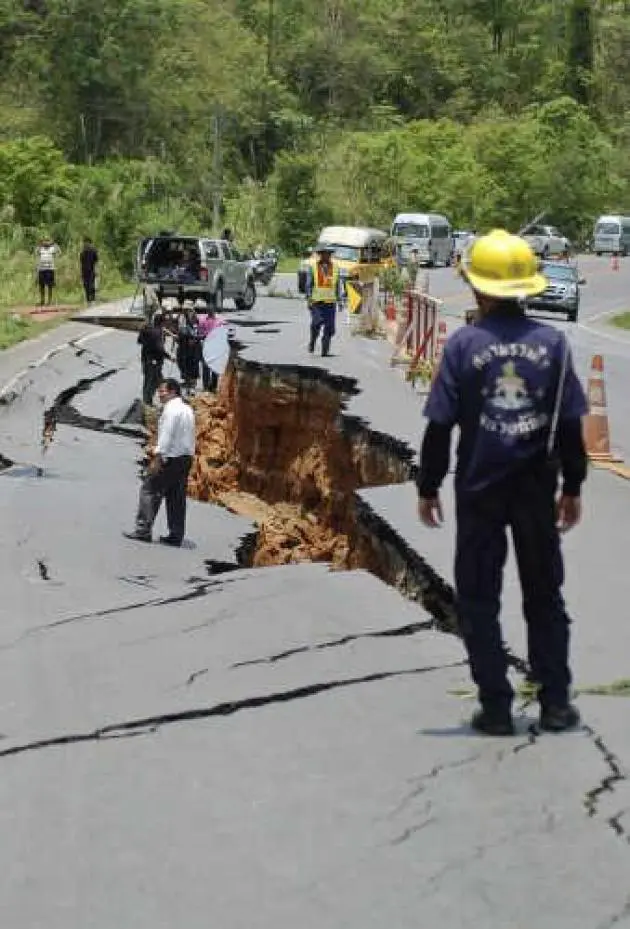
Residents in Taungoo, Kengtung, Mandalay, Nay Pyi Taw and Yangon felt tremors on Monday evening, after an earthquake measuring 5.8 on the Richter Scale shook Thailand and Myanmar.
The epicentre of the quake is in Chiang Rai, the North of Thailand, according to the Department of Meteorology and Hydrology (DMH), with the city of Kyaingtong being the closest but most damage occurring in Tachilake.
“This region has fault lines aligned northeast to southwest and is also known as the Golden Triangle Fault Line. Probably, one of these lines might cause the quake. Tachilake would be damaged the most. It also struck Mandalay but no fatalities reported so far,” informed by Soe Thura Tun, vice secretary general of the DMH.
Meteorologist Dr. Tun Lwin warned the residents in eastern Shan State about aftershocks.
“As the epicentre was along the Thai-Lao-Myanmar borderline, it also struck some cities in Myanmar and Laos too. The residents of eastern Shan State should be cautious about aftershocks,” Dr. Tun Lwin explained.
Residents in Yangon felt the tremors, with many living in high-rise buildings evacuating as a precaution.
“I live on the 8th floor and did not recognise it when it began at 5.30pm. The building and ceiling lights shook then everyone in our building got afraid and evacuated the building,” said one resident from Pearl Condominium.
Earthquakes are common in the region with underground rifts stretching along the Myanmar-Thailand border. A 6.4 magnitude earthquake was recorded in 2007 and a 6.8 magnitude earthquake hit the same area in 2011.
Myanmar rests on one of the world's two main earthquake belts, with one of its many fault lines running 1,000 km north to south through the country's agriculturally rich central plain, placing major Burmese cities, including Mandalay, Bago and Yangon, at risk.
In 2011, a 6.8 quake shook Myanmar's northeastern Shan State, killing 74 and affecting 18,000. When a 7.3 magnitude earthquake struck Bago in 1930, many buildings were destroyed and 500 people died. The tremors were felt 80 km away in Yangon, resulting in 50 more deaths.
According to the Myanmar Earthquake Committee, a 6.8 quake with the epicentre near Lay Dwin Zin, Chaung Tha and Pa Zi Gyi vilages hit the country in 2012.
Last year, the Myanmar Engineering Society (MES) signed an agreement with the Malaysian Rubber Export Promotion Council (MREPC) for cooperation in construction of earthquake-proof buildings in the country.
The programme was aimed at providing technical cooperation for seismic buildings to be built in the future. The Malaysian counterpart will provide technological know-how for the construction of buildings and bridges. Rubber blocks were cited as the latest in quake-proof material.
Myanmar also worked with United Nations Human Settlements Programme (UN-HABITAT) to do earthquake risk assessment in three cities, namely Bago, Taungoo and Sagaing cities, which have a population 412,730, 231,460 and 291,230 respectively. The programme was launched in Nay Pyi Taw in December 2012.
In Thailand, the Engineering Institute of Thailand under HM The King's Patronage (EIT) held a press conference today, suggesting that there should be a post-quake 72-hour monitoring conducted. It warned that mudslides or landslides are possible in areas affected by the quake after the likely heavy rain, which has been forecast later this week, as debris and sliding rocks stirred up by the tremors may later be washed away or cause further damage.
People living at the foothills or in mountainous areas 50 metres from the epicentre are advised to check out any cracks, and relocate if necessary until rainstorms had subsided.
The engineers also warned that after the quake near the Phayao faultline, there were other faultlines at risk for future quakes, especially the Phan faultline, as greater magnitudes that could be as strong as 6.6 or greater.
In Chiang Rai, the head of Buddha image in Udomwaree Temple fell to the ground and the ceilings from some houses collapsed. Passengers fled the terminal in Chiang Rai airport when pieces of the ceiling began to fall.
