
The Lady celebrates a milestone


Play
Opposition leader turns 69 on June 19, but report finds that women's participation in governance is lowest in the region
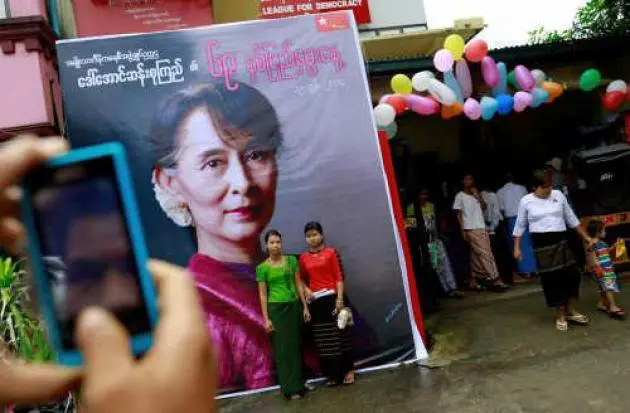
Born in 1945 in Yangon, opposition leader Aung San Suu Kyi celebrated her 69th birthday on June 19.
Her supporters hosted a party at the head office of National League for Democracy (NLD), to which she is the chairperson.
At 69, the Lady still fights on, despite a series of measures that bar her from regaining power from the military, which has controlled the country for decades.
A parliamentary panel recently voted to retain a key constitutional clause that bars anyone married to a foreigner or with children of foreign citizenship from becoming head of state. Suu Kyi’s late husband was British, as are her two sons.
Saying this is “unacceptable democratically speaking that one person should be targeted by ... the Constitution”, she said “Whether or not I become president in future depends on the will of the people.”
Meanwhile, joint research by Myanmar Development Resource Institute - Centre for
Economic and Social Development, a government-affiliated think-tank, and the Asia Foundation found that women’s participation in governance remains low.
“Key findings indicate that apart from their involvement in civil society and NGOs, women are found to have very low levels of participation in various governance institutions operating at the subnational level in Myanmar,” the report says.
The country was at the bottom among Southeast Asian countries in women’s representation in governance. It was also ranked 170th of 185 selected countries worldwide.
In a study from February to May, with interviews conducted in Karen and Kachin states as well as Yangon and Nay Pyi Taw, researchers found there were no women were leading township-level administration, while only 0.11 per cent of village heads were women. Most of these women were working in Karen State.
The study found that only 4.42 per cent of lawmakers in the Union Parliament were women. The amount was lower in state and regional governments, at just 2.83 per cent.
The report identified a number of barriers to women’s participation at regional and state level. They include “a lack of experience and certain skills, low bargaining power within households, high time constraints, restrictions on women’s travel, traditional norms that ascribe authority to men over women, a lack of confidence, and a lack of acceptance of female leadership”.
Barriers, however, are beginning to fall. “A number of the barriers to women’s participation are starting to fall, making the possibility of increasing women’s participation more likely,” the report said.
It also found factors that encourage women’s participation. These include, “a relatively high
level of gender equality in formal educational attainment, the deliberate actions of certain governance actors to increase women’s participation, and the women who are already in leadership positions inspiring and enabling other women to follow in their footsteps”.
Increased participation of women in politics is important because “evidence suggests that women prioritise issues of health, education, sanitation and microfinance”. Increasing their participation is likely to make governments more responsive to these critical develop issues, “and have general positive effects on
the performance of governance institutions”, the report says.
