
Rice tops list in new national export strategy
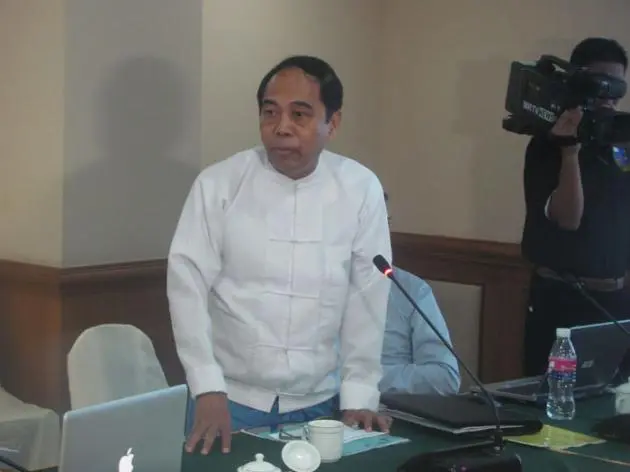


Top commerce adviser calls on traders to shift mindset from focus on cheap exports and short-term gains
Rice exports will be prioritised in the new national export strategy that the government began implementing yesterday, according to the Ministry of Commerce.
Rice will be among six key goods prioritised for export, said Maung Aung, senior adviser to the ministry.
He said the other five are beans, pulses and oil seed crops; fish and crustaceans; textiles and garments; wood products; and rubber.
Maung Aung said the government had its eye on the European market for rice, adding that Myanmar rice had the advantage of being cheaper than rice from Vietnam and Thailand. "That’s why rice has a lot of potential for exporting. We hope it will be followed by beans, fishery products, wood-based products, and garments respectively," he said.
He made the comments on the sidelines of a meeting on the export strategy at the office of the Union of Myanmar Federation of Chambers of Commerce and Industry.
In the 2012-2013 fiscal year, Myanmar exported 1.4 million tonnes of rice. In the last fiscal year, rice exports fell to 1.2 million tonnes of rice.
Maung Aung said that the new five-year strategy would help reduce poverty. Implementation began yesterday, after three stages: preliminary consultations, detailed discussions, and designing the strategy.
So far, only the oil and gas sector has drawn large amounts of money into the country. Oil and gas exports were excluded from the strategy because they do not support socio-economic development or create many job opportunities, Maung Aung said.
The adviser also urged business leaders to increasing the quality of their products and increase production of value-added products and services.
"In an effort to boost our exports, we should focus not only on quantities of products but also on their quality. We need to export quality products. To establish a good brand for our country, we need to penetrate good markets," he said.
Maung Aung added that exporters should take advantage of the opportunities created by Myanmar’s inclusion in the European Union’s generalised scheme of preferences, as well as similar trade privileges offered by Russia, Turkey, Norway, Australia and Japan. Myanmar has applied for inclusion in Washington’s generalised system of preferences. Business leaders expect that President Barack Obama will announce Myanmar’s inclusion in this system –which provides duty-free access to the US market – when he visits Myanmar in November.
China has promised to increase its orders for Myanmar rice by 2 per cent next month, though negotiations are still underway. Inspectors from China have been invited to Myanmar this month to forge a quality-control agreement. The inspectors are from China’s administration of quality supervision, inspection and quarantine agency, which monitors imports. After the agreement is signed, Myanmar can resume official exports of rice to China.
Maung Aung underscored the importance of educating farmers and traders about the importance of improving the quality of their rice. "Production of value-added rice will depend on farmers so we need to raise their awareness," he said, adding that practical training was critical.
Domestic traders also need to rethink their objectives. "We have acquired the bad habit of exporting low-quality products to other countries," Maung Aung said, adding that this resulted in lost opportunities for a greater share of large markets. "For example, in India and Thailand, the government never blocks exports of quality rice. Unlike Myanmar, every country tries to export its best products to other countries in order to win international markets. We should also apply such practice. The traders’ practice is totally wrong," he explained.
The economist sees "Paw San Hmwe" rice as having the greatest export potential, as demand for it is already high in the domestic market.
The only reason huge demand for it is lacking in other markets is that traders have failed to promote it, he said.
"To be honest, most traders only look at their profits. They usually don’t look at long-term growth. They don’t look at the image of our country. They just think of how much profit they will make. We should try to change their mindsets," Maung Aung said.
Traders must adhere to business ethics and consider the long-term effects of their business on the country'’ welfare and image, he told the meeting of business leaders.
In the last fiscal year, total trade amounted to more than US$25 billion. This year, the total trade volume is expected to reach about $30 billion, Maung Aung said.
