
Merkel vows backing in return for minority rights


Play
Berlin - Chancellor Angela Merkel on Wednesday pledged further economic support for Myanmar if it holds fair elections next year and does more to protect ethnic minorities.
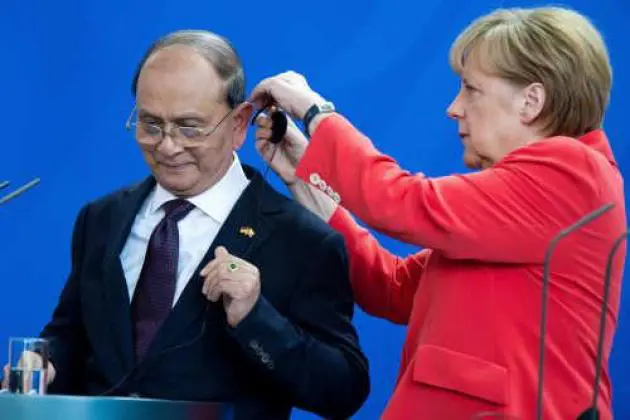
After talks with Myanmar's President Thein Sein, Merkel told a joint news conference that Germany was ready to boost investment and development aid but would keep a close eye on human rights in the country, which is still emerging from decades of military rule and international isolation.
"Myanmar is a country with many ethnic groups and for economic growth, peace is of course required, and peace requires compromise and tolerance with regard to minorities," she said.
Merkel hailed "democratic progress" in the Southeast Asian nation, notably in the area of press freedom, but said Berlin was watching preparations for parliamentary elections due in 2015.
"We expressed our hope that the elections will be free, fair and transparent," she said of her talks with Thein Sein, a former general whose quasi-civilian regime is now pursuing reforms.
Merkel also called on the government in Nay Pyi Taw to show greater tolerance towards ethnic minorities.
Former general Thein Sein's visit to Germany was part of a 10-day trip to Europe aimed at drumming up financial aid for his nation, which was once an international pariah because of its military regime and poor human rights record.
Merkel said that Germany has increased its financial aid to Myanmar to help speed up the country's drive for democratic and political reform.
"We have further intensified our development cooperation," Merkel said.
Myanmar's long period of isolation has left it one of the most underdeveloped countries in the world despite it having important offshore oil and gas deposits. Myanmar and its population of 52 million people need German technical and financial aid to help underpin the country's transformation, which began three years ago after its first elections in 20 years, officials said.
"If we have economic success, then democratisation is easier," the Myanmar leader said, adding that change had brought with it difficulties.
But he said his country had "been able to carry out this enormous democratic process without spilling blood".
Merkel said Germany was focusing aid for Myanmar on an overhaul of its educational system and assistance to small- and medium-sized companies "in regions where there are ethnic conflicts".
Thein Sein, whose government has been accused of failing to stem two years of sporadic anti-Muslim violence, remarked he was the first president of Myanmar to visit Germany in three decades.
Speaking through an interpreter, he noted that his country had only been on a path to democracy for three years.
"In this time we had a lot of difficulties" but were able to pursue reforms "without bloodshed".
He said he would support opposition calls to amend Myanmar's constitution before the elections if they receive backing of parliament and voters in a referendum.
Deadly clashes in Rakhine two years ago have since led to periodical violence across the country, most recently in the second largest city of Mandalay.
Activists have also accused the government of backsliding on press reforms with the introduction of vague media laws and the prosecution of several local journalists.
Opposition leader and Nobel laureate Aung San Suu Kyi warned on a visit to Berlin in April that her country, despite the reforms, "is not yet a democracy".
Thein Sein, whose visit to Berlin also marks the 60th anniversary of the establishment of diplomatic ties between his nation and Germany, is to hold talks Thursday with German President Joachim Gauck. After Berlin, Thein Sein is to travel to Switzerland and the Netherlands. Last year, Thein Sein visited Britain, Norway, France, Italy and Belgium.
