
Peace talks amid doubts
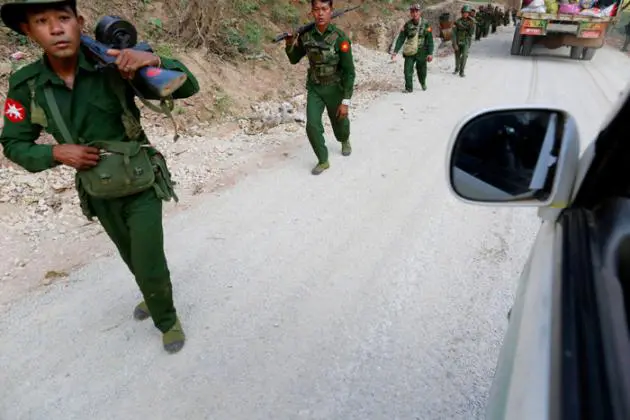


The Myanmar government's peace talks with armed ethnic groups are on course, a negotiator from the Myanmar Peace Centre (MPC) insists, rejecting the contention that they are failing.
There is grave doubt that the peace talks with 16 armed groups and alliances, aimed at reaching a nationwide ceasefire accord, have any traction left.
But several months after they met late last year, all parties will be back at the negotiating table in Yangon on March 16, said Aung Naing Oo, a senior member of the government-supported MPC team negotiating with the armed groups.
At best, analysts say, the talks could help limit the spread of new fighting. But they are unlikely to lead to agreement on the much-coveted nationwide ceasefire pact that President Thein Sein wants signed to end decades of civil war.
Apart from the conflict in the north-eastern Kokang border region in Shan state that has ruffled ties with China, there have been skirmishes between government troops and armed elements of the Karen National Union and Shan State Army-South.
Against this backdrop, analysts following the talks say they are flagging.
In a commentary last week week published on the website of the Democratic Voice of Burma (DVB), a Chiang Mai-based broadcaster, Kachin analyst Pangmu Shayi wrote that the peace process was in its "death throes".
Separately a Yangon-based independent analyst familiar with the situation, asking not to be named, in an e-mail response to The Straits Times wrote: "The peace process is dead. Nothing more of major significance will happen before the elections."
A general election, seen as a litmus test of Myanmar's democratic transition, is due near the end of this year.
But the talks do offer an opportunity to head off a larger crisis, the analyst acknowledged.
"Both sides are very keen on the March 16 meeting to prevent contagion from the Kokang conflict which could otherwise get very serious, with public opinion strongly behind the army," he wrote.
The talks that earlier failed to achieve a nationwide ceasefire on February 12 - the president's preferred target date - are soured by the outbreak of conflict in the Kokang border region.
In a telephone interview, Nai Hong Sar, leader of the Nationwide Ceasefire Coordination Team which represents the 16 armed groups and is taking part in the talks, said that while both sides want peace, there is still distrust.
But with the Kokang fighting escalating, "if we do not have further meetings, it will be difficult to resolve our political conflicts".
Ethnic armed groups have rejected the army's contention that they are supporting the ethnic Chinese Kokang. But in an interview this week with Voice of America, Peng Daren, commander of the Kokang forces, said "counting four other ethnic groups including Kachin Independence Organisation, who are helping us, we have 4,000-5,000 soldiers in total".
The fierce battles in the border region, triggered by ambushes on army units by the Kokang, have left scores on both sides dead and driven thousands of locals across the border into camps in China, prompting concern from Beijing.
The Myanmar army, stung by the earlier ambushes and buoyed by unaccustomed public support, has said it will not stop until the Kokang are defeated.
Still, insisted Aung Naing Oo: "The peace talks are not dead."
Apart from the 16 groups the government has been negotiating with, others will be at the talks as observers, he said in an interview. These will include the United Wa State Army and the Mongla Group - both of which have been accused by the Myanmar army of supporting Kokang.
The Kachin Independence Organisation will bring a big delegation, he said.
"They have committed to five days of talks," he added. "One of the key agenda (objectives) is reducing tensions and potential clashes.
